Respect for Charlie Kirk
Due to the sensitive nature of the subject matter I think it’s important to state up front that I have a fond admiration for Charlie Kirk and for how respectably he stood up strong for what he believed in. Of course, this is an opinion I formed of him from others who I admire who were actually his friends, as I never personally followed him or paid much attention to any of his work.
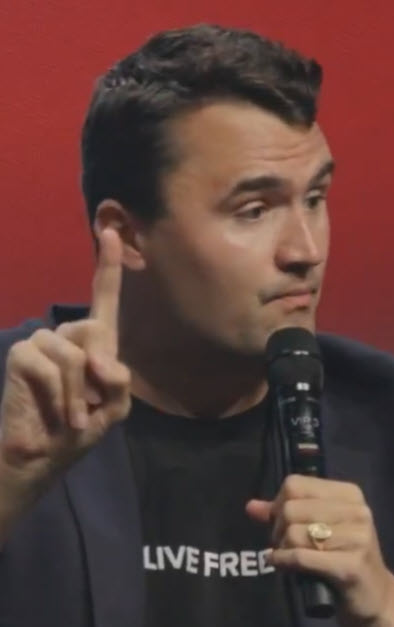
Charlie Kirk supported free speech. I feel like in that spirit he would applaud any discussion on these topics, even if he would disagree with my point of view. I really appreciate the thoughts expressed by Michael Shermer in his commentary, The Assassination of Charlie Kirk: Shermer Reflects on Political Violence. Starting at 26:32 min:
“If you’re not able to articulate your own position enough that the other side can counter it and then you can counter their counter, then you don’t really know your own position. That’s John Stewart Mill’s classic argument – He who knows only his own side of the case hardly knows that. So the value of having the Charlie Kirks of the world engaging with students actually even if they stay liberal or they become more liberal, at least they’ll be rationally liberal. They’ll have arguments, not straw man arguments, but steel man arguments by which I mean they could steel man the conservative position and then if they can refute it how much stronger their position will be… All of us are flawed. The fallibilism assumption is true. We’re all fallible. The only way to find out if you’ve gone off the rails or if you’re wrong is to talk to somebody who disagrees with you, which was what Charlie Kirk did so masterfully.”
Why I Wrote This Article
On Sep 11th, the day after Charlie Kirk was shot, some friends of mine shared a clip of Charlie speaking, where he said:
“[A] Spiritual battle is coming to the West. And the enemies are wokeism or Marxism combining with Islamism, to go after what we call, ‘the American way of life’.
…
The outgrowth of the scriptures gave us Western civilization. And this is where I think is a great rallying cry. Doesn’t matter if you’re Hispanic, doesn’t matter if you’re Asian, doesn’t matter if you’re black or white. Everybody, if you are Christian and Jesus Christ is your Lord and Savior, these two threats are combining forces to come after us. And it’s time that the church stands and rises up against it.”1
This essay explores how rhetoric that divides the world into ‘good’ and ‘bad’—even in defense of faith—risks becoming a form of the very violence it seeks to oppose.
I Felt Disturbed by Charlie’s Rhetoric
From the perspective of my conservative friends, this rhetoric resonates deeply. I, however, found it troubling—not because I deny that wokeism and Marxism present real threats, or that it doesn’t matter if one is Hispanic or Asian or black or white. I am a Christian and hope to be able to endure all that that sacred title may require of me. I, too, share the longing expressed by Charlie in that brief clip: to build community with fellow Christians in this nation around the principles of liberty. To experience the simple joys of life—marriage, homeownership, raising children, watching them ride their bikes until sunset, and sending them to good schools—all safeguarded by the foundational principles upon which our Constitution was built.
Kirk’s rhetoric unsettled me because it conflicts with principles from Marshall Rosenberg’s Nonviolent Communication (NVC), which I studied extensively (see my previous blog post, Nonviolent Communication and Crucial Conversations.) NVC identifies judgmental language that labels groups as “good” or “bad” as inherently violent, fostering division rather than understanding.
One instructor of the NVC method gives the example of what he called the “John Wayne effect.” In this scenario, if you walk into a bar and meet someone who is a good guy, you buy him a beer. If he’s a bad guy, you either beat him up or shoot him. This kind of programing makes up most of our entertainment, including that intended for children.
“This violence typically constitutes the ‘climax’ of the show. Viewers, having been taught that bad guys deserve to be punished, take pleasure in watching this violence.” (Rosenberg, Marshall. Nonviolent Communication: A Language of Life: Life-Changing Tools for Healthy Relationships, p. 17-18)
As with any good skill, the practice of learning to apply the principals of nonviolent communication requires effort. For those of us who seek to invite a true spirit of compassion and understanding into an increasingly divided world, such skills are imperative. I invite the reader to consider learning more about Rosenberg’s model of nonviolent communication.
With these ideas in mind, watch the Charlie Kirk clip above and consider this question: does Charlie identify any “bad guys” in his rhetoric? To the extent that his words suggest judgment or assign blame, this reflects the kind of language that Marshall Rosenberg describes as “violent” in his book.
A New Christian Right
To understand why this rhetoric troubles me, it helps to look at how similar frameworks have appeared across the political spectrum.
Another reason I found this clip disturbing relates to an article published by American Reformer, an online magazine founded in 2021 by Josh Abbotoy and Timon Cline. The publication describes its mission as promoting “a vigorous Christian approach to the cultural challenges of our day,” and it often aligns with post-liberal and Christian nationalist perspectives that critique classical liberalism in favor of a more authoritarian, faith-infused political order.
It’s not an article I would recommend; in fact, I found it rather disheartening. For reference, you can read it here:
The Liberal Consensus and the New Christian Right
The Hoax
What makes this article noteworthy is that it contains the same kind of rhetoric Charlie uses in the clip I referenced earlier. The key point, however, is that this piece was actually submitted to American Reformer as a hoax by James Lindsay — an atheist author and vocal critic of “woke” ideologies. Lindsay rewrote sections of Karl Marx and Friedrich Engels’ Communist Manifesto (1848), substituting Marxist terms such as “bourgeoisie” and “proletarians” with Christian nationalist equivalents like “liberal establishment” and “true Christian Right.” He retained the original’s rhetorical structure and even adapted its famous opening line to read: “A rising spirit is haunting America: the spirit of a true Christian Right.” The essay, submitted under the pseudonym Marcus Carlson, called for a revolutionary “New Christian Right” to overthrow liberal elites — directly mirroring the Manifesto’s call for proletarian uprising.
The Editors’ Response
American Reformer published the piece on November 13, 2024, titled “The Liberal Consensus and the New Christian Right”. After Lindsay revealed the hoax on X (formerly Twitter) on December 3, 2024, the editors updated the byline to credit Lindsay explicitly, added a note acknowledging the Marxian origins (“The following article was written by James Lindsay, who, as an avowed atheist, is not eligible for publication in American Reformer“), and kept it online. They described it as an “exploitation of our high-trust approach” but stood by its non-Marxist elements, announcing stricter editorial screening.
The article portrays liberals as an oppressive class suppressing Christian values, urging a “rising Christian Right” to seize power through cultural and political revolution. Lindsay later explained this exposed how “Woke Right” rhetoric adopts Marxist conflict theory (oppressors vs. oppressed) but swaps class struggle for religious-cultural warfare.
Lindsay’s Motivation
Lindsay has long been a vocal critic of “wokeness,” even likening it to a form of religious belief, and has described the Social Justice Movement as his “ideological enemy.” So why is he now targeting what’s being called the “woke right”? Lindsay argues that his goal is to keep conservatism from being hijacked by the same vices it once opposed, such as seeing society as divided into oppressed/oppressor groups and justifying extreme measures to dismantle “unjust” systems.
Though he opposed Donald Trump in the 2016 United States presidential election, Lindsay announced his intention to vote for Trump in the 2020 election, arguing that the danger of “wokeness” is much greater than that of a Trump presidency.
Lindsay considered Charlie Kirk a great friend. Even though he does not believe in God, Lindsay was invited to speak at Turning Point USA more than once because of the importance of his message on the dangers of “wokeness”. (See Lindsay’s interview with Allie Beth Stuckey, around 8 min)
Marxixm on the Left vs Marxism on the Right
In the clip that I started this article with above, Charlie associates wokeism with Marxism. He says:
“[A] spiritual battle is coming to the West. And the enemies are wokeism or Marxism combining with Islamism, to go after what we call, ‘the American way of life’.”
In this, Charlie was not wrong—the threat of wokeism on the left does draw from Marxist ideology. But does responding in kind—by adopting Marxist frameworks or tactics to combat what some perceive as leftist threats—make the approach from the right any less destructive or “violent”?
One of Charlie Kirk’s lasting contributions was his commitment to open debate. I must admit that I have not spent extensive time studying his discussions with college students or his broader body of work. As I write this, it has been three weeks since Charlie’s assassination, and much of my free time since then has been devoted to gathering my thoughts for this reflection, inspired by the brief 1-minute and 15-second clip at the start of this article. Spending additional hours analyzing his debate style would only draw focus away from the core message I hope to convey here.
If what we celebrate in Charlie’s work is his commitment to open, constructive, and nonviolent dialogue, then let this example remind us of the same. As we engage in difficult conversations, may we do so with the intent to foster understanding and kindness—even toward those with whom we profoundly disagree.
Consider one simple example. I recently came across this meme on my Facebook feed, and it left me feeling agitated:
“When George Floyd died they burned down cities.
When Charlie Kirk died we host vigils.
We are not the same.”
Ask yourself—does this kind of rhetoric promote nonviolence and compassion, or does it instead fuel the dangerous fire of polarization and hostility? If we truly desire peace, how can we learn to discourage, rather than feed, the language of violence?
Mark Jurgensmeyer explored how religion and violence seems to be so often linked together in his book Terror in the Mind of God. He notes:
“What puzzles me is not why bad things are done by bad people, but rather why bad things are done by people who otherwise appear to be good – in cases of religious terrorism, by pious people dedicated to a moral vision of the world.” (Terror in the Mind of God. Berkeley: University of California Press, 2003, p. 7.)
It is no less violent when Marxist tactics are used to turn the right against the left than when those same tactics are used to turn the left against the right.
As Christians, I believe we are called to do better.
Joseph Smith gave sound counsel when he said:
“If you do not accuse each other, God will not accuse you. If you have no accuser you will enter heaven, and if you will follow the revelations and instructions which God gives you through me, I will take you into heaven as my back load. If you will not accuse me, I will not accuse you. If you will throw a cloak of charity over my sins, I will over yours—for charity covereth a multitude of sins.” (History of the Church, 4:445)
Satan’s accusations against us are not said to be unwarranted or unsupported. He is not necessarily accusing his victims unjustly. If any of us were measured against an absolute standard of obedience, faithfulness, or virtue, we would all necessarily fail. Satan does not need to use an unfair standard to accuse and condemn us. (all have sinned and fall short – Rom 3:23)
When we take it upon ourselves to condemn others, we risk mirroring the spirit of accusation rather than Christ’s call to forgiveness. What Christ has asked us to do is forgive, or as Joseph put it, not to accuse each other.
Doesn’t The Book of Mormon Contain a Lot of Violence?
The Book of Mormon comes into this era with the longest and most robust scriptural treatment of violence of any other scriptural record, including the Koran. The numerous “war chapters” of the Book of Mormon provide us with greater instruction on this subject than any other single source of God’s word on violence.
If Christ’s message is one of peace and forgiveness, why does the Book of Mormon—which claims to be a special witness of Christ—contain so much violence? Moroni answers this question by giving us this chilling warning:
“Any nation that upholds such secret conspiracies, to get power and wealth, until they spread throughout the nation, will be destroyed. … Therefore, you Gentiles, it’s God’s wisdom for you to be shown these things, so you’ll repent of your sins and not allow these murderous conspiracies, that are always set up for power and money, to control you, so that you won’t provoke your own destruction. Indeed, the sword of the justice of the Eternal God will fall upon you, to your ruin and destruction, if you allow these things to continue. Therefore the Lord commands you, when you see these things come among you, to wake up to a sense of your awful situation because of this secret society that’s come into existence among you. Woe to this conspiracy on account of the blood of those who have been killed; they cry out from the dust for vengeance upon it, and upon those who make and support it.” (Ether 3:18, Covenant of Christ Edition)
Marxism in the Book of Mormon?
In the Book of Mormon we read an account of a city that was completely destroyed by Lamanites in a single day. “[I]n the eleventh year of reign of judges… on the fifth day of second month”, the city of Ammonihah is destroyed by Lamanites. (Alma 16:1-2). These Lamanites were mostly Amlicites and Amulonites2 who were after the order of Nehor (Alma 21:4). The people of the city of Ammonihah were also after the order of Nehor (Alma 16:11).
For those familiar with the story, it is interesting to note that the native Lamanites who were killing the people of Anti-Nephi-Lehi end up joining the people of God (Alma 24:25-26), but the Amlicites and Amulonites, who were native Nephites that had rejected Christ, end up destroying those of their own Nehor belief in Ammonihah.
Nehor is introduced in Alma 1. He advocated priestcraft, where priests should be paid and supported by the people rather than laboring for themselves (Alma 1:3). He taught that all will be saved, denying the need for repentance, which contradicts the Nephite prophets’ teachings about Christ’s atonement and accountability (Alma 1:4). When he was confronted by Gideon who stood up against his teachings, Nehor attempted to enforce his teachings through violence by killing Gideon with the sword (Alma 1:9).
Nehor’s brief but impactful presence establishes a pattern of apostasy and priestcraft that challenges Nephite society throughout the Book of Alma.
I wouldn’t argue that the teachings of Nehor can necessarily be classified as Marxist. However, in the context of this article, it’s worth noting that both Nehor’s teachings and Marxism share a similar tendency: they divide people into opposing groups and set them against one another. Throughout the Book of Alma, the followers of Nehor repeatedly attempt to impose their beliefs through both violent language and violent acts.
Can We Make Room for Faith and Nonviolence?
In my personal journal from an entry in Aug of 2020, I confided in a co-worker with this lament:
“Am I being too idealistic? Since the beginning of this world, all the major prophesies point to us in our day. We are physically living in the time where Zion is supposed to come before the end of all things, and here we sit – where Enoch and Melchizedek had the faith to stop the mouths of lions, quench the violence of fire, have the dead restored back to life, etc. – and we are relying on the 2nd Amendment and our guns to save us?”
The violence of today is another sign along the downward trek into corruption that will mirror the days of Noah (Matt 24:37-39). It will eventually become more widespread. So much so that there will be a single place, alone and apart from the anger and corruption that leads to violence:
“And it shall come to pass among the wicked that every man that will not take his sword against his neighbor must needs flee unto Zion for safety, and there shall be gathered unto it out of every nation under heaven, and it shall be the only people that shall not be at war one with another.” (D&C 45:68-69)
If Charlie Kirk’s legacy is one of bold conviction, may ours be one of courageous compassion — the willingness to confront division without replicating its violence.
- The source of the video short clip is an X (formerly Twitter) post by Charlie Kirk (@charliekirk11) from August 13, 2025 (Post ID: 1955752635971330419). The full speech is from a Turning Point USA Faith “Freedom Night” live event on August 13, 2025. ↩︎
- The book of Mormon identifies the two groups as “Amalekites and the Amulonites.” (see Alma 21:4 and 24:1). Royal Skousen argues in his Analysis of Textual Variants of the Book of Mormon (Part Three, pp. 1605–1609) that the Amalekites referenced later in the Book of Alma (e.g., Alma 21:2–3) were the same group as the Amlicites (followers of the Nephite dissenter Amlici from Alma 2–3), with the difference arising from scribal spelling inconsistencies in the original and printer’s manuscripts. I adopt Skousen’s view. ↩︎