The New Christian Right and the Language of War

This essay explores how rhetoric that divides the world into ‘good’ and ‘bad’—even in defense of faith—risks becoming a form of the very violence it seeks to oppose.

Respect for Charlie Kirk

Due to the sensitive nature of the subject matter I think it’s important to state up front that I have a fond admiration for Charlie Kirk and for how respectably he stood up strong for what he believed in. Of course, this is an opinion I formed of him from others who I admire who were actually his friends, as I never personally followed him or paid much attention to any of his work.

Charlie Kirk supported free speech. I feel like in that spirit he would applaud any discussion on these topics, even if he would disagree with my point of view. I really appreciate the thoughts expressed by Michael Shermer in his commentary, The Assassination of Charlie Kirk: Shermer Reflects on Political Violence. Starting at 26:32 min:

“If you’re not able to articulate your own position enough that the other side can counter it and then you can counter their counter, then you don’t really know your own position. That’s John Stewart Mill’s classic argument – He who knows only his own side of the case hardly knows that. So the value of having the Charlie Kirks of the world engaging with students actually even if they stay liberal or they become more liberal, at least they’ll be rationally liberal. They’ll have arguments, not straw man arguments, but steel man arguments by which I mean they could steel man the conservative position and then if they can refute it how much stronger their position will be… All of us are flawed. The fallibilism assumption is true. We’re all fallible. The only way to find out if you’ve gone off the rails or if you’re wrong is to talk to somebody who disagrees with you, which was what Charlie Kirk did so masterfully.”

Why I Wrote This Article

On Sep 11th, the day after Charlie Kirk was shot, some friends of mine shared a clip of Charlie speaking, where he said:

“[A] Spiritual battle is coming to the West. And the enemies are wokeism or Marxism combining with Islamism, to go after what we call, ‘the American way of life’.

The outgrowth of the scriptures gave us Western civilization. And this is where I think is a great rallying cry. Doesn’t matter if you’re Hispanic, doesn’t matter if you’re Asian, doesn’t matter if you’re black or white. Everybody, if you are Christian and Jesus Christ is your Lord and Savior, these two threats are combining forces to come after us. And it’s time that the church stands and rises up against it.”1

This essay explores how rhetoric that divides the world into ‘good’ and ‘bad’—even in defense of faith—risks becoming a form of the very violence it seeks to oppose.

I Felt Disturbed by Charlie’s Rhetoric

From the perspective of my conservative friends, this rhetoric resonates deeply. I, however, found it troubling—not because I deny that wokeism and Marxism present real threats, or that it doesn’t matter if one is Hispanic or Asian or black or white. I am a Christian and hope to be able to endure all that that sacred title may require of me. I, too, share the longing expressed by Charlie in that brief clip: to build community with fellow Christians in this nation around the principles of liberty. To experience the simple joys of life—marriage, homeownership, raising children, watching them ride their bikes until sunset, and sending them to good schools—all safeguarded by the foundational principles upon which our Constitution was built.

Kirk’s rhetoric unsettled me because it conflicts with principles from Marshall Rosenberg’s Nonviolent Communication (NVC), which I studied extensively (see my previous blog post, Nonviolent Communication and Crucial Conversations.) NVC identifies judgmental language that labels groups as “good” or “bad” as inherently violent, fostering division rather than understanding.

One instructor of the NVC method gives the example of what he called the “John Wayne effect.” In this scenario, if you walk into a bar and meet someone who is a good guy, you buy him a beer. If he’s a bad guy, you either beat him up or shoot him. This kind of programing makes up most of our entertainment, including that intended for children.

“This violence typically constitutes the ‘climax’ of the show. Viewers, having been taught that bad guys deserve to be punished, take pleasure in watching this violence.” (Rosenberg, Marshall. Nonviolent Communication: A Language of Life: Life-Changing Tools for Healthy Relationships, p. 17-18)

As with any good skill, the practice of learning to apply the principals of nonviolent communication requires effort. For those of us who seek to invite a true spirit of compassion and understanding into an increasingly divided world, such skills are imperative. I invite the reader to consider learning more about Rosenberg’s model of nonviolent communication.

With these ideas in mind, watch the Charlie Kirk clip above and consider this question: does Charlie identify any “bad guys” in his rhetoric? To the extent that his words suggest judgment or assign blame, this reflects the kind of language that Marshall Rosenberg describes as “violent” in his book.

A New Christian Right

To understand why this rhetoric troubles me, it helps to look at how similar frameworks have appeared across the political spectrum.

Another reason I found this clip disturbing relates to an article published by American Reformer, an online magazine founded in 2021 by Josh Abbotoy and Timon Cline. The publication describes its mission as promoting “a vigorous Christian approach to the cultural challenges of our day,” and it often aligns with post-liberal and Christian nationalist perspectives that critique classical liberalism in favor of a more authoritarian, faith-infused political order.

It’s not an article I would recommend; in fact, I found it rather disheartening. For reference, you can read it here:

The Liberal Consensus and the New Christian Right

The Hoax

What makes this article noteworthy is that it contains the same kind of rhetoric Charlie uses in the clip I referenced earlier. The key point, however, is that this piece was actually submitted to American Reformer as a hoax by James Lindsay — an atheist author and vocal critic of “woke” ideologies. Lindsay rewrote sections of Karl Marx and Friedrich Engels’ Communist Manifesto (1848), substituting Marxist terms such as “bourgeoisie” and “proletarians” with Christian nationalist equivalents like “liberal establishment” and “true Christian Right.” He retained the original’s rhetorical structure and even adapted its famous opening line to read: “A rising spirit is haunting America: the spirit of a true Christian Right.” The essay, submitted under the pseudonym Marcus Carlson, called for a revolutionary “New Christian Right” to overthrow liberal elites — directly mirroring the Manifesto’s call for proletarian uprising.

The Editors’ Response

American Reformer published the piece on November 13, 2024, titled “The Liberal Consensus and the New Christian Right”. After Lindsay revealed the hoax on X (formerly Twitter) on December 3, 2024, the editors updated the byline to credit Lindsay explicitly, added a note acknowledging the Marxian origins (“The following article was written by James Lindsay, who, as an avowed atheist, is not eligible for publication in American Reformer“), and kept it online. They described it as an “exploitation of our high-trust approach” but stood by its non-Marxist elements, announcing stricter editorial screening.

The article portrays liberals as an oppressive class suppressing Christian values, urging a “rising Christian Right” to seize power through cultural and political revolution. Lindsay later explained this exposed how “Woke Right” rhetoric adopts Marxist conflict theory (oppressors vs. oppressed) but swaps class struggle for religious-cultural warfare.

Lindsay’s Motivation

Lindsay has long been a vocal critic of “wokeness,” even likening it to a form of religious belief, and has described the Social Justice Movement as his “ideological enemy.” So why is he now targeting what’s being called the “woke right”? Lindsay argues that his goal is to keep conservatism from being hijacked by the same vices it once opposed, such as seeing society as divided into oppressed/oppressor groups and justifying extreme measures to dismantle “unjust” systems.

Though he opposed Donald Trump in the 2016 United States presidential election, Lindsay announced his intention to vote for Trump in the 2020 election, arguing that the danger of “wokeness” is much greater than that of a Trump presidency.

Lindsay considered Charlie Kirk a great friend. Even though he does not believe in God, Lindsay was invited to speak at Turning Point USA more than once because of the importance of his message on the dangers of “wokeness”. (See Lindsay’s interview with Allie Beth Stuckey, around 8 min)

Marxixm on the Left vs Marxism on the Right

In the clip that I started this article with above, Charlie associates wokeism with Marxism. He says:

“[A] spiritual battle is coming to the West. And the enemies are wokeism or Marxism combining with Islamism, to go after what we call, ‘the American way of life’.”

In this, Charlie was not wrong—the threat of wokeism on the left does draw from Marxist ideology. But does responding in kind—by adopting Marxist frameworks or tactics to combat what some perceive as leftist threats—make the approach from the right any less destructive or “violent”?

One of Charlie Kirk’s lasting contributions was his commitment to open debate. I must admit that I have not spent extensive time studying his discussions with college students or his broader body of work. As I write this, it has been three weeks since Charlie’s assassination, and much of my free time since then has been devoted to gathering my thoughts for this reflection, inspired by the brief 1-minute and 15-second clip at the start of this article. Spending additional hours analyzing his debate style would only draw focus away from the core message I hope to convey here.

If what we celebrate in Charlie’s work is his commitment to open, constructive, and nonviolent dialogue, then let this example remind us of the same. As we engage in difficult conversations, may we do so with the intent to foster understanding and kindness—even toward those with whom we profoundly disagree.

Consider one simple example. I recently came across this meme on my Facebook feed, and it left me feeling agitated:

“When George Floyd died they burned down cities.
When Charlie Kirk died we host vigils.
We are not the same.”

Ask yourself—does this kind of rhetoric promote nonviolence and compassion, or does it instead fuel the dangerous fire of polarization and hostility? If we truly desire peace, how can we learn to discourage, rather than feed, the language of violence?

Mark Jurgensmeyer explored how religion and violence seems to be so often linked together in his book Terror in the Mind of God. He notes:

“What puzzles me is not why bad things are done by bad people, but rather why bad things are done by people who otherwise appear to be good – in cases of religious terrorism, by pious people dedicated to a moral vision of the world.” (Terror in the Mind of God. Berkeley: University of California Press, 2003, p. 7.)

It is no less violent when Marxist tactics are used to turn the right against the left than when those same tactics are used to turn the left against the right.

As Christians, I believe we are called to do better.

Joseph Smith gave sound counsel when he said:

“If you do not accuse each other, God will not accuse you. If you have no accuser you will enter heaven, and if you will follow the revelations and instructions which God gives you through me, I will take you into heaven as my back load. If you will not accuse me, I will not accuse you. If you will throw a cloak of charity over my sins, I will over yours—for charity covereth a multitude of sins.” (History of the Church, 4:445)

Satan’s accusations against us are not said to be unwarranted or unsupported. He is not necessarily accusing his victims unjustly. If any of us were measured against an absolute standard of obedience, faithfulness, or virtue, we would all necessarily fail. Satan does not need to use an unfair standard to accuse and condemn us. (all have sinned and fall short – Rom 3:23)

When we take it upon ourselves to condemn others, we risk mirroring the spirit of accusation rather than Christ’s call to forgiveness. What Christ has asked us to do is forgive, or as Joseph put it, not to accuse each other.

Doesn’t The Book of Mormon Contain a Lot of Violence?

The Book of Mormon comes into this era with the longest and most robust scriptural treatment of violence of any other scriptural record, including the Koran. The numerous “war chapters” of the Book of Mormon provide us with greater instruction on this subject than any other single source of God’s word on violence.

If Christ’s message is one of peace and forgiveness, why does the Book of Mormon—which claims to be a special witness of Christ—contain so much violence? Moroni answers this question by giving us this chilling warning:

“Any nation that upholds such secret conspiracies, to get power and wealth, until they spread throughout the nation, will be destroyed. … Therefore, you Gentiles, it’s God’s wisdom for you to be shown these things, so you’ll repent of your sins and not allow these murderous conspiracies, that are always set up for power and money, to control you, so that you won’t provoke your own destruction. Indeed, the sword of the justice of the Eternal God will fall upon you, to your ruin and destruction, if you allow these things to continue. Therefore the Lord commands you, when you see these things come among you, to wake up to a sense of your awful situation because of this secret society that’s come into existence among you. Woe to this conspiracy on account of the blood of those who have been killed; they cry out from the dust for vengeance upon it, and upon those who make and support it.” (Ether 3:18, Covenant of Christ Edition)

Marxism in the Book of Mormon?

In the Book of Mormon we read an account of a city that was completely destroyed by Lamanites in a single day. “[I]n the eleventh year of reign of judges… on the fifth day of second month”, the city of Ammonihah is destroyed by Lamanites. (Alma 16:1-2). These Lamanites were mostly Amlicites and Amulonites2 who were after the order of Nehor (Alma 21:4). The people of the city of Ammonihah were also after the order of Nehor (Alma 16:11).

For those familiar with the story, it is interesting to note that the native Lamanites who were killing the people of Anti-Nephi-Lehi end up joining the people of God (Alma 24:25-26), but the Amlicites and Amulonites, who were native Nephites that had rejected Christ, end up destroying those of their own Nehor belief in Ammonihah.

Nehor is introduced in Alma 1. He advocated priestcraft, where priests should be paid and supported by the people rather than laboring for themselves (Alma 1:3). He taught that all will be saved, denying the need for repentance, which contradicts the Nephite prophets’ teachings about Christ’s atonement and accountability (Alma 1:4). When he was confronted by Gideon who stood up against his teachings, Nehor attempted to enforce his teachings through violence by killing Gideon with the sword (Alma 1:9).

Nehor’s brief but impactful presence establishes a pattern of apostasy and priestcraft that challenges Nephite society throughout the Book of Alma.

I wouldn’t argue that the teachings of Nehor can necessarily be classified as Marxist. However, in the context of this article, it’s worth noting that both Nehor’s teachings and Marxism share a similar tendency: they divide people into opposing groups and set them against one another. Throughout the Book of Alma, the followers of Nehor repeatedly attempt to impose their beliefs through both violent language and violent acts.

Can We Make Room for Faith and Nonviolence?

In my personal journal from an entry in Aug of 2020, I confided in a co-worker with this lament:

“Am I being too idealistic? Since the beginning of this world, all the major prophesies point to us in our day. We are physically living in the time where Zion is supposed to come before the end of all things, and here we sit – where Enoch and Melchizedek had the faith to stop the mouths of lions, quench the violence of fire, have the dead restored back to life, etc. – and we are relying on the 2nd Amendment and our guns to save us?”

The violence of today is another sign along the downward trek into corruption that will mirror the days of Noah (Matt 24:37-39). It will eventually become more widespread. So much so that there will be a single place, alone and apart from the anger and corruption that leads to violence:

“And it shall come to pass among the wicked that every man that will not take his sword against his neighbor must needs flee unto Zion for safety, and there shall be gathered unto it out of every nation under heaven, and it shall be the only people that shall not be at war one with another.” (D&C 45:68-69)

If Charlie Kirk’s legacy is one of bold conviction, may ours be one of courageous compassion — the willingness to confront division without replicating its violence.

  1. The source of the video short clip is an X (formerly Twitter) post by Charlie Kirk (@charliekirk11) from August 13, 2025 (Post ID: 1955752635971330419). The full speech is from a Turning Point USA Faith “Freedom Night” live event on August 13, 2025. ↩︎
  2. The book of Mormon identifies the two groups as “Amalekites and the Amulonites.” (see Alma 21:4 and 24:1). Royal Skousen argues in his Analysis of Textual Variants of the Book of Mormon (Part Three, pp. 1605–1609) that the Amalekites referenced later in the Book of Alma (e.g., Alma 21:2–3) were the same group as the Amlicites (followers of the Nephite dissenter Amlici from Alma 2–3), with the difference arising from scribal spelling inconsistencies in the original and printer’s manuscripts. I adopt Skousen’s view. ↩︎
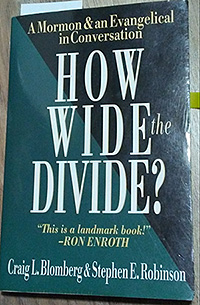
How Wide the Divide

My first reaction to the book is to applaud that this conversation takes place between anyone of differing denominations.

Book review by Jay Ball

I just finished reading “How Wide the Divide, A Mormon & an Evangelical in Conversation” by Steven Robinson from BYU and co-authored with a member of the Evangelical-based Denver Theological Seminary faculty, Craig Blomberg. (In the following article, page references without any other citation are to this book.)
As an LDS reader, my first reaction to the book is to applaud that this conversation takes place between anyone of differing denominations.

Like Paul in Philippians 4:2 pleading with Euodia and Syntyche to “agree with each other in the Lord” (NIV), or “be of the same mind” (KJV), I think there is value in finding common ground wherever two or more can gather in His name (see Matt 18:20).

I thought these remarks in the concluding chapter made a good summation of the book:

“As we have made clear throughout this book, we do not claim to have settled all of our differences. Neither do we believe that Mormons and Evangelicals would, or even ought to, accept one another’s baptisms. We harbor no delusions that this modest dialog will in any way diminish the extent to which LDS missionaries bear testimony to Evangelicals or to which Evangelicals witness to Mormons, nor do our respective beliefs convince us that such activity should diminish. But we can hope and pray that as sincere, spiritual men and women (who all claim the name of Christ) talk about their beliefs and life pilgrimages with each other, they might do so with considerably more accurate information about each other and in a noticeably more charitable spirit than has often been the case, after the pattern set by common intent of both ‘sides’ to confess, to worship, and to serve that Jesus Christ who is described in the New Testament as our Lord…
Might we look forward to the day when youth groups or adult Sunday-school classes from Mormon and Evangelical churches in the same neighborhoods would gather periodically to share their beliefs with each other in love and for the sake of understanding, not proselytizing?” (How Wide the Divide, p. 190-191)

As with any good discussion, there is value in what we can learn from each other in the process, particularly as it may enlighten our understanding about things that matter most. I admire how the two authors often disagreed with each other in a way that was not harsh or contentious. This I feel is a sign of a good and healthy discussion. It is with such a spirit I add my own commentary to this discussion.

As I often do, I made observations in the margins as I read. One thing I think that surprised me most is Robinson’s focus and desire that Mormons be accepted as Christian. Part of me agrees with his argument:

“If Armenian and Calvinist Evangelicals can disagree over free will, election, irresistible grace, eternal security and so on, and yet both be deemed Christians, I don’t think merely believing in a subdivided heaven or believing that Jesus can save even the dead should get the LDS thrown out of Christendom.” (Robinson, p. 154)

On the other hand, I see value in LDS just conceding the point and proudly acknowledge we are NOT part of Historic Christianity. We disagree with Historic Christianity, and at a fundamental level we denounce it as false. We claim to be a restoration of Primitive Christianity. We do not share in accepting the creeds which Christ to Joseph Smith denounced as “an abomination in His sight.” (Joseph Smith History 1:19.)

Oddly, from the LDS end, we try and avoid the argument, fit in, claim we are “good Christians too,” and part of the larger community of churches. We try to make ourselves seem more like Historic Christianity, and avoid or discard what once set us apart.

On LDS Orthodoxy

In his effort for Mormons to be accepted as Christian, Robinson makes a point to establish certain things as agreeing with (or not) to a standard Mormon orthodoxy, as if there was such a thing.

“By and large the LDS do not worry as much about orthodoxy within their own community as do Evangelicals, though there is such a thing as LDS orthodoxy. In short run, LDS orthodoxy is defined by the Standard Works of the Church (Bible, Book of Mormon, Doctrine and Covenants, and Pearl of Great Price) as interpreted by the General Authorities of the Church – the current apostles and prophets.” (p. 15)

The phrase “LDS orthodoxy” seems like a bit of an oxymoron to me. We have no ‘orthodox’ creed in Mormonism. We welcome all truth, from whatever source. We have the following statements in our scriptures:

“We claim the privilege of worshiping Almighty God according to the dictates of our own conscience, and allow all men the same privilege, let them worship how, where, or what they may.” (11th Article of Faith)

Despite this, Robinson continues to assert “official LDS teaching” in his discussion on various topics.

“The official doctrine of the Church on deification does not extend in essentials beyond what is said in the Bible, with its Doctrines and Covenants parallels.” (Robinson, p. 85)

One important LDS cannon of “official doctrine” that Robinson has missed giving any reference to is Lectures on Faith which was never “officially” removed from the cannon (i.e. it was removed from the cannon without a vote). See BYU publication by Larry E. Dahl, Authorship and History of the Lectures on Faith.  Speaking about the Lectures on Faith Bruce R. McConkie said “It was written by the power of the Holy Ghost, by the Spirit of Inspiration. It is in effect, eternal scripture. It is true.” (The Lord God of Joseph Smith, discourse delivered January 4, 1972)

Robinson states that “it is the official teaching of the LDS Church that God the Father has a physical body (Doctrine and Covenants 130:22).” (p. 87) Though I don’t disagree with this as coming from an “official” LDS source, in fairness we must also recognize that “The Father is a personage of spirit, glory, and power” as taught in Lectures on Faith 6, paragraph 2.

Speaking for Latter-day Saints, Robinson says that “it irritates the LDS that some Evangelicals keep trying to add the Journal of Discourses or other examples of LDS homiletics to the canon of LDS Scripture.” (p. 73)

I have wondered if it shouldn’t be equally irritating that what is currently taught over the pulpit in General Conference is considered LDS Scripture.

Blomberg later was quick to observe:

“Robinson insists that the Adam-God theory, as proposed by the various interpreters of Brigham Young, makes no sense and was never officially endorsed. These clarifications would seem to hold the door open for significant rapprochement between Evangelicals and Mormons on these doctrine, especially if the LDS can continue to avoid using unofficial statements from their past to define present official LDS doctrine.” (P. 109, emphasis mine.)

Adam-God theory was endorsed over the pulpit by Brigham Young in general conference of the Church. Would that not make it both “official” and “endorsed”?

Brigham Young taught over the pulpit and in conference talks, Adam-God theory, polygamy as essential to salvation, and, the day we accept blacks into priesthood will be the day the Church is in apostasy. Yet today the Church denies these are doctrines.

“[W]e can’t logically assert that pronouncements made by prophets today are to be automatically accepted, without question and testing by the Spirit and other standards as the “mind and will of the Lord,” yet discount the unacceptable teachings of former prophets in this dispensation as being only personal views. The same standard must apply – how we regard the statements of prophets on doctrinal matters today is how we must regard the doctrinal statements of prophets who lived a century ago, and vice versa.” (Duane S. Crowther, Thus Saith the Lord, 1980, p 236)

I don’t point this out to be contrary or argumentative. I only want to make the point that we should not be too quick to declare what is “official LDS teaching”. As Robinson rightly observes:

“Pure LDS orthodoxy can be a moving target, depending on which Mormon one talks to.” (p. 14)

On LDS Scripture

Robinson later states:

“For Latter-day Saints, the Church’s guarantee of doctrinal correctness lies primarily in the living prophet, and only secondarily in the preservation of the written text.” (p. 57)

Personally I know of no “guarantee of doctrinal correctness” in the Church.
Church President Joseph Fielding Smith wrote:

“It makes no difference what is written or what anyone has said, if what has been said is in conflict with what the Lord has revealed, we can set it aside. My words, and the teachings of any other member of the Church, high or low, if they do not square with the revelations, we need not accept them. Let us have this matter clear. We have accepted the four standard works as the measuring yardsticks, or balances, by which we measure every man’s doctrine… If Joseph Fielding Smith writes something which is out of harmony with the revelations, then every member of the Church is duty bound to reject it.” (Doctrines of Salvation, 3 vols., edited by Bruce R. McConkie [Salt Lake City: Bookcraft, 1954-1956], 3: 203.)

On page 58, Robinson comments that one role of an apostle is: “he is necessary to authoritatively interpret [the written word of God]”. I believe an apostle/prophet’s role has more to do with crying repentance* and leading men to make their own connection with heaven than “authoritatively interpreting” scripture. The expectation that we must rely on some man with authority to interpret scripture for us misses the point of the purpose of scripture. I previously wrote about this:

“The purpose of scripture is to lead us to Christ, to have His [law] written in our hearts (Heb 10:16), and make Him alive in us (Eph 2:5). Despite the claim that the scriptures alone save, we can’t ignore the promise of scripture that God will continue to speak to man. (James 1:5-6; Joel 2:28-32) If the Bible does not ultimately lead us to Christ, what purpose does it serve? The objective is to come to Him, not the Bible (or a prophet). Scripture is a means, not an end. What difference is there between a Mormon who blindly follows a prophet that he assumes cannot lead him astray, and a Christian who blindly assumes that scripture alone can save by trusting in the word alone, without getting a witness from God Himself? The missing element in both is the personal connection with Christ. Do I turn to Him? Do I know His voice? (John 10:27)” 

In Robinson’s eagerness for Mormons to be accepted as Christian among the Evangelical community, he inadvertently reveals something about the “vanity and unbelief” of the LDS Church, for which the Lord in September of 1832 declares “the whole church under condemnation.” (See D&C 84:54-57.)

“[T]he King James Bible is the LDS Bible. No other version, not even the JST [Joseph Smith Translation of the Bible], supplants the KJV.” (Robinson, p. 59)

I agree with Robinson’s assessment but I would ask why this is so? As recent as 1993 Elder Oaks has reaffirmed that it is because of neglect and treating lightly the things given through Joseph Smith that “has continued the condemnation in our own day.” (Another Testament of Jesus Christ, Dallin H. Oaks BYU Fireside June 1993.) If the Church is under condemnation for treating lightly what was given through Joseph, why do we continue to hold the KJV in higher esteem than the JST?

“Leaders of the LDS Church from Joseph Smith to the present have tended to use the Bible even more than the Book of Mormon in their teaching and preaching.” (Robinson, p. 59)

The historical LDS neglect for the Book of Mormon is not realized by most Latter-day Saints today. For example, from the founding of Brigham Young University in 1875 until 1937, there was not a single course offered on the Book of Mormon at BYU. It was not until 1961 the Book of Mormon became a required course for all BYU freshmen.

“The first fully developed Book of Mormon class was offered in 1937 by Amos Merrill. Introduction of this course faced considerable resistance from some department administrators, remembers Hugh Nibley, and key faculty members wondered how the Book of Mormon could be taught for a whole semester.” (Reynolds, Noel B. The Coming Forth of the Book of Mormon in the Twentieth Century, BYU Studies, 1999)

Working in a climate of intellectual hostility, Hugh Nibley is given credit for being responsible for much of the change in focus to taking the Book of Mormon seriously in the Church and is highly commended by Neal A. Maxwell. You can read Noel B. Reynolds complete publication here.

In their joint conclusion of Chapter 1, Blomberg and Robinson assert, “We further agree that JST variants do not necessarily imply that the KJV text is corrupt.” (p. 75) If the JST “variants” don’t imply this, the Book of Mormon certainly does. The Book of Mormon says of the Bible that many covenants have been taken away from it (1 Nephi 13:26), and that the right ways of the Lord might be perverted to blind the eyes and harden the hearts of the children of men (v 27). Plain and precious things have been taken from it (v 28) and because of this many do stumble and Satan has great power over them (v 29).

All this aside, the Bible is still acknowledged as important scripture to Latter-day Saints.

“It is [the orthodox churches] post biblical creeds that are identified in Joseph Smith’s first vision as an ‘abomination,’ but certainly not their individual members or their members’ biblical beliefs.” (Robinson, p. 61)

That Joseph Smith didn’t have anything but the Bible to go by when he went to the woods to pray, gives evidence that (even if you are a believing Mormon) one can find God by trusting in the word of the Bible alone.

“In the Washington lecture, Joseph underscored beliefs held in common with other Christians. ‘We teach nothing but what the Bible teaches. We believe nothing, but what is to be found in this Book.’ … Joseph insisted more than once that ‘all who would follow the precepts of the Bible, whether Mormon or not, would assuredly be saved.’” (Richard Bushman, Rough Stone Rolling, p. 195)

On Salvation

In Chapter 1 on Scripture Robinson states,

“In the LDS view the fullness of the gospel is ultimately necessary to salvation, but not necessarily in this life.” (Robinson, p. 73, emphasis mine.)

I agree with Robinson that one way the term “fullness of the gospel” is used in scripture is as a way to identify Christ revealing Himself to mankind, thereby redeeming mortals from the fall, as we read in D&C 76:14. Later in this section we read how this is something intended for us to experience “in the flesh” (v 118), or in other words in this life (see Alma 34:32).

Later Robinson continues to justify the idea that we can procrastinate the day of our repentance** and still come out OK in the end:

“[W]e believe the gospel is preached to the ignorant and rebellious spirits (pneumata) in prison, that they may repent and accept Christ and live (Jn 5:25-29; 1 Pet 3:18-20; 4:6). Like the prodigal son of the parable, they may yet reconsider, repent and be joyfully received among the mansions of the Father although perhaps not to receive all that will be inherited by the more faithful.” (p. 150)

Robinson is touching upon a topic about which Nephi could well be warning us as Latter-day Saints in 2 Nephi 28:8:

“And there shall also be many which shall say: Eat, drink, and be merry; nevertheless, fear God—he will justify in committing a little sin; yea, lie a little, take the advantage of one because of his words, dig a pit for thy neighbor; there is no harm in this; and do all these things, for tomorrow we die; and if it so be that we are guilty, God will beat us with a few stripes, and at last we shall be saved in the kingdom of God.” (As an aside, reference to “Zion” in verses 21 and 24 is another indication this warning can apply to Latter-day Saints.)

“Mormons believe the saved will be divided into three broad divisions called kingdoms or glories. The lowest of these is the telestial glory.” (Robinson, p. 152)

In this view, all but those who become “sons of perdition” are “saved”. Viewed another way, however, “damnation” is to cease progressing or to regress. Anything less than the Celestial Kingdom has an end, beyond which we cannot have an increase (see D&C 131:4).

“The LDS believe there will be millions, even billions, of good souls who will come from the east and the west to sit down with Abraham, Isaac and Jacob in the celestial kingdom.” (Robinson, p. 153)

I frankly don’t know where Robinson gets this idea or how to reconcile it with Matt 7:14, “Because strait is the gate, and narrow is the way, which leadeth unto life, and few there be that find it.”

At its core, the definition of salvation is getting to know the Lord. (John 17: 3). Yet Blomberg argues:

“[S]hould we not expect an omnipotent, omniscient, omnipresent God not to be fully comprehensible by mere mortals?” (Blomberg, p. 121, along with its footnote 31 on p. 217, which says: “Augustine once wrote, ‘If you can understand it, it’s not God'”.)

Although written by one who is now excommunicated from the LDS Church, I still like how this author poses it:

“The doctrine of the Trinity which was settled, if not created, in the Council of Nicea is an impediment, and not an advantage, to knowing God. If ‘life eternal’ is to ‘know God’ (as John declared–see John 17:3) then of what value is a doctrine that makes God ‘incomprehensible?'” (Denver Snuffer, Trinitarian Impediment)

Joseph Smith elaborates on what salvation means in Lectures on Faith. (See Lecture 7.)

“And for any portion of the human family to be assimilated into their [God the Father and the Son’s] likeness is to be saved; and to be unlike them is to be destroyed: and on this hinge turns the door of salvation.” (para 16)

Nephi adds, “He that endureth to the end, the same shall be saved. And now, my beloved brethren, I know by this that unless a man shall endure to the end, in following the example of the Son of the living God, he cannot be saved.” (2 Nephi 31:15-16)

Robinson claims that Mormons believe, like the Evangelical, that Christ first saves us, and then transforms us to be like Him:

“Latter-day Saints believe that God intends through the gospel of Jesus Christ to transform those who are saved by Christ to be like Christ.” (Robinson, p. 80)

Later Robinson acknowledges the role grace plays in our path to salvation:

“To Latter-day Saints the glorified and resurrected Christ illustrates in his person what the saved can become through his grace.” (Robinson, p. 81)

For me, the subject of how grace relates to salvation is easier to grasp when I understand that Mormons and Evangelicals define grace differently. When I view grace as not only “unmerited favor”, but also includes the gift or power to become more like Christ (Strong’s Concordance 5485: grace as a gift or blessing, favor, kindness), then it’s easier to appreciate how the two groups treat this word differently.

Seeing grace as “an enabling power to move closer to God”, or as “an increase of light” helps explain:

“It is by grace we do the required works to be saved. As explained in Philip. 2:13: “For it is God which worketh in you both to will and to do his good pleasure.” As Paul explained in Romans 6:1-2 concerning those who are born again through Christ: “What shall we say then? Shall we continue in sin, that grace may abound? God forbid.” We must escape sin by the grace of God and then do the works that testify we are in possession of God’s grace. As James explained in James 2:17-20: “Even so faith, if it hath not works, is dead, being alone. Yea, a man may say, Thou hast faith, and I have works: shew me thy faith without thy works, and I will shew thee my faith by my works. Thou believest that there is one God; thou doest well: the devils also believe, and tremble. But will thou know, O vain man, that faith without works is dead?” If we are saved by the grace of God our works will testify of that grace within us. Without the works of righteousness, put within us by being born again, a new creation of Christ’s, we may claim to have been saved by grace, but it is without proof.” (Denver Snuffer, Are We Saved by Grace or Works?)

As Robinson and Blomberg jointly concluded in Chapter 4:

“If we do not demonstrate good works, some sign over time, of a changed life, our professions of faith are ultimately futile.” (p. 187)

Moving On…

I try to resist contentious debate, so there is a certain level of inner conflict I grapple with as I try to avoid being too critical. But it was difficult to resist the temptation to engage the challenge Blomberg invited with the use of phrases like “there is not a shred of historical evidence…”, “No early Christian theologian ever…”, or “all agree…”. My purpose has been to call out what I see as I read the book, so although I do not include all my observations, I’ve chosen to point out the few that stood out most.

“[A]ll these Christian concepts included in the pre-Christian stories of the Book of Mormon were supposedly known in earlier times. The trouble is that there is not a shred of historical evidence from the ancient world that the suppression of such literature ever took place. It defies imagination how every hint of the vast panorama of New Testament texts and concepts could have disappeared from both the Old Testament and other pre-Christian Jewish documents, even had a censor deliberately tried to destroy it all.” (Blomberg, p. 49)

Margaret Barker, bible scholar, author of 17 books, and Methodist preacher, provides a good amount of scholarly historical evidence of precisely the very thing that “defies [Blomberg’s] imagination”. She has written much on how “King Josiah changed the religion of Israel in 623 BC… King Josiah’s purge is usually known as the Deuteronomic reform of the temple.” (See What Did King Josiah Reform? Presented 6 May 2003 at Brigham Young University).

The topic can be debated, but to suggest there “is not a shred of historical evidence” that suppression of ancient scripture took place is simply incorrect.

On Polytheiphobia

Blomberg’s position on polytheism is understandable. This is a fundamental belief of most modern Christian religions.

“At this point we find ourselves face to face with polytheism, which the Bible defines as idolatry.” (Blomberg, p. 105)

“[T]he most crucial observation about God to be gleaned from the Old Testament is its unrelenting monotheism.” (Blomberg, p. 113)

I’m surprised, however, at Robinson’s attempts to distance himself from the negative connotation of the term polytheism:

“Thus there are three divine persons, but only one Godhead. Clearly Prof. Blomsberg feels that such a Godhead is unlikely and that defining the Godhead so runs a risk of polytheism – but that is not the LDS belief. It would horrify the Saints to hear talk of ‘polytheism.’” (Robinson, p. 132)

Many LSD scholars argue that the earliest form of Judaism was not monotheistic. The “Elohim” of the Old Testament was plural. Hence the English translation of “God” (in Hebrew “Elohim” a plural noun) saying “Let us make man in our image.” To be true to the text it was necessary to employ a plural pronoun. Therefore, right at the beginning of the scriptural text God is plural.

“Whom do we believe? Do we work with the picture of a pagan religion which the Deuteronomists reformed and brought back to pristine purity, or do we work with a picture of an ancient religion virtually stamped out by the Deuteronomists, who put in its place their own version of what Israel should believe? This question is not just academic, a fine point to be debated about the religions of the ancient Near East. Our whole view of the evolution of monotheism in Israel depends on the answer to this question, for the Deuteronomists are recognized as the source of the ‘monotheistic’ texts in the Old Testament and as the first to suppress anthropomorphism. If the Deuteronomists do not represent the mainstream of Israel’s religion (and increasingly they are being recognized as a vocal minority), was the mainstream of that religion not monotheistic and did it have anthropomorphic theophanies at its centre?” (Margaret Barker, The Great Angel, 1992, p. 14)

On Jesus as Son of God the Father

In Chapter 2 footnote 28, Blomberg writes:

“In some of the literature I read, Jesus’ references to himself as ‘Son of Man’ were used as further support for the physicality of God the Father. But this was an established Hebrew idiom, used to mean ‘human’ (see throughout the book of Ezekiel), including a quasi-messianic title for a very exalted human (in Dan 7:13-14). While a massive debate among Bible scholars of all traditions rages as to which of these backgrounds is more important for Jesus’ use of the term, all agree that it predicates nothing about the God who is Jesus’ Father.” (p. 213)

I would say not “all agree”. Quoting Margaret Barker again:

“Matthew records Jesus’s own version of the judgement theme in Matt. 25.31-46. The language is very revealing, as are the presuppositions that scholars bring to it. The Son of Man comes with his angels and takes his place on the throne as judge. He is the King acting for another whom he names as his Father (Matt. 25.34). There is no need to suggest that the ancient role of Yahweh the King has been altered and given to the Son of Man, thus causing complications and making it necessary for Matthew to alter the story so as to make a place for ‘the Father’:
‘In verse 34 [of Matt 25] the Son of Man is referred to as ‘the king’. This may be a trace of an earlier state of the parable, in which the reference was to God himself. If so, the address to those on the right hand as ‘blessed of my Father’ must be regarded as a Matthaean adjustment.’ (B. Lindars, Jesus Son of Man, London 1983, p. 126)
None of this is necessary if we recognize that Yahweh was the Son of Elyon, the Man. The Son of Man as vicegerent is exactly like the role of Philo’s Logos and this is corroborated in Mark 2.10 and parallels where the Son of Man has authority to forgive sins on earth and in John 5.27 where the Father has given authority to the Son of Man to act as judge. Mark hints at this identification of Yahweh and the Son of Man in Mark 2.28; the Son of Man is Lord even of the Sabbath.” (The Great Angel, 1992, p. 226)

In Chapter 3 on Christ and The Trinity, Blomberg challenges that:

“No early Christian theologian ever identified Jesus as a completely separate God from Yahweh, Lord of Israel. ‘Son of God’ in it’s Jewish context was a messianic title (see Ps 2; 89; 2 Sam 7:14) and was never taken to suggest that Jesus was the literal, biological offspring of his heavenly Father.” (p. 116)

I don’t know about early Christian theologians, but:

“Several writers of the first three Christian centuries show by their descriptions of the First and Second persons of the Trinity whence they derived these beliefs. El Elyon had become for them God the Father and Yahweh, the Holy One of Israel, the Son, had been identified with Jesus.” (Margaret Barker, First sentence of Chapter 10 titled “The Evidence of the First Christians” from The Great Angel, p. 190. The entire chapter is about this subject. I would commend it to anyone who has a desire to pursue the topic further.)

To Conclude

Finally, there were several places that I underlined without commentary because I simply agreed with the text.

I thought this was a fair observation by Robinson:

“[B]ut [Joseph Smith] cannot be accused of contradicting the Bible where the Bible is silent. There are gaps. I would be quite happy to have Evangelicals say to me, ‘You Latter-day Saints have beliefs and doctrines on subjects about which the Bible is silent or ambiguous.’ That is a fair statement. However, I believe it is unfair to say, ‘Since you hold opinions where the Bible is silent, you contradict the Bible,’ or, ‘Because you contradict Nicaea and Chalcedon, you contradict the Bible.’” (p. 86)

Amen to this insightful comment by Blomberg:

“[W]e cannot claim to have really surrendered control of our lives to Jesus if we consciously refuse to obey him in certain areas of our lives. We have to be willing, at least in principle, to turn over everything to him. The paradoxical conclusion that perhaps captures the correct balance here is that ‘salvation is absolutely free, but it will cost us our very lives.’ Our old natures must be crucified with Christ regularly.” (p. 169)

One last word

This statement by Robinson & Blomberg in the Joint Conclusion of book caught my attention:

“Many of these characteristics [of what defines a ‘cult’] no longer apply to Mormonism” (p. 193)

“No longer apply”, suggesting that they once did? What characteristics did at one time apply in the past that “no longer apply” now?

I have addressed this topic in an article of its own – Do I Belong to a Cult?


*   “As I have sought direction from the Lord, I have had reaffirmed in my mind and heart the declaration of the Lord to ‘say nothing but repentance unto this generation.’ (D&C 6:9; D&C 11:9.)” (President Ezra Taft Benson, Cleansing the Inner Vessel, April General Conference, 1986)

**   “And now, as I said unto you before, as ye have had so many witnesses, therefore, I beseech of you that ye do not procrastinate the day of your repentance until the end; for after this day of life, which is given us to prepare for eternity, behold, if we do not improve our time while in this life, then cometh the night of darkness wherein there can be no labor performed.” (Alma 34:33)

Download this article as PDF file

Super Hero Writes Children’s Book

Jay Ball writes children’s book teaching forgiveness and the atonement of Christ.

Little Ip and The Land of Contrasts is a children’s book that will give you a powerful new perspective on Christ. It does this in parable form, without mentioning “God” or “Christ” at all. The good news is that because it’s a children’s book – written in story-book fashion – the message is easy to digest and entertaining to read.

I wrote this book in response to a child’s question, “Daddy, why didn’t God save Jesus on the cross?”

Good question.

Christians and Non-Christians have been asking this question for ages.

Have you ever tried to research this question yourself? Did you feel like you were suddenly swimming in a sea of Christian philosophy, where the explanations were clouded in complex theological theories using big words like “atonement”, “expiation”, and “propitiation”?

This book is not meant to be a tool to convert the world to Christianity. Its main message is on forgiveness, but it also simplifies the complex question, “why did Christ have to suffer, why couldn’t God save him?”