When the standard curriculum of church meetings and conferences does not go deeper than basic milk, and my craving for deeper life sustaining meat is filled by a personal study, how do I avoid the natural tendency to become prideful because I think I now know more than others?
Preparing for last week’s Sunday School lesson (yes, I’ve actually been preparing and giving a lesson during this time of quarantine), I ran across this quote by President Kimball, explaining how dangerous pride can be.
“To satisfy his own egotism, to feed his pride, to justify vain ambition, a man took a stand against the authorities of the Church. He followed the usual pattern – no apostasy at first, only superiority of knowledge with mild criticism of the brethren. He loved the brethren, he said, but they had failed to see things he saw. He was sure his interpretation was correct. He would still love the Church, he maintained, but his criticism grew and developed into ever-widening areas. He could not yield in good conscience; he had his pride. He spoke of it among his associates; he talked of it at home. His children did not accept his philosophy wholly, but their confidence was shaken in the brethren and the Church. They were frustrated and became inactive. They married out of the Church and he lost them. He later realized the folly of his position and returned to humbleness and activity, but he had lost his children.”
(Kimball, Spencer W. Faith Precedes the Miracle. Salt Lake City: Deseret Book, 1972, p. 306.)
This caught my attention because I have questioned authorities of the church myself on this blog. These remarks by President Kimball raised a couple of questions of my own. He stated that this man’s children’s “confidence was shaken in the brethren and the Church”. The first question to cross my mind was, why is the focus on the “brethren and the Church”? Why not Christ? And where it appears I am guilty of what could be seen as questioning authority myself, my second question is, what is the difference between “taking a stand against the authorities of the Church”, and raising concerns, asking questions, or pointing out what appears to be inconsistencies between teachings in conference and scripture? What if, instead of being seen as antagonistic to authorities, my questions are sincere concerns, rooted in a desire to truly understand what it means to come unto Christ?
In a recent Address to CES Religious Educators, Elder M. Russell Ballard counseled teachers to prepare and teach in ways that will “build unwavering faith in the lives of our precious youth… Gone are the days,” he said, “when a student raised a sincere concern and a teacher bore his or her testimony as a response intended to avoid the issue. Gone are the days when students were protected from people who attacked the Church.” (An Evening with Elder M. Russell Ballard, Salt Lake Tabernacle, February 26, 2016)
Perusing back through my previous blog posts, I took note of some sincere questions that have risen from things general authorities have taught.
I was confused at Elder Bruce R. McConkie’s teaching that “gaining a special, personal relationship with Christ… is both improper and perilous” in my post, The Emerging Church – To Creed or Not to Creed
Elder W. Mark Basset confused me by teaching that “We were never expected ‘to have a perfect knowledge of things’ during this mortal existence.” in my post Why Do We Avoid Delving into Mysteries?
The question isn’t do I think I know something Elder Basset or Elder Corbridge does not. The question is, did Joseph Smith know something they do not? When what the authority of the church teaches differs from what Joseph taught or what scripture teaches, or what Christ taught, how do I reconcile that? President Joseph Fielding Smith put it this way:
“It makes no difference what is written or what anyone has said, if what has been said is in conflict with what the Lord has revealed, we can set it aside. My words, and the teachings of any other member of the Church, high or low, if they do not square with the revelations, we need not accept them. Let us have this matter clear. We have accepted the four standard works as the measuring yardsticks, or balances, by which we measure every man’s doctrine… If Joseph Fielding Smith writes something which is out of harmony with the revelations, then every member of the Church is duty bound to reject it.”
(Doctrines of Salvation, 3 vols., edited by Bruce R. McConkie [Salt Lake City: Bookcraft, 1954-1956], 3: 203.)
Lest I be misunderstood, I agree with President Kimball in the opening quote. He is cautioning us against pride. The antidote to which, as President Benson reminded us, is humility.
When the standard curriculum of church meetings and conferences does not go deeper than basic milk, and my craving for deeper life sustaining meat is filled by a personal study, how do I avoid the natural tendency to become prideful because I think I now know more than others? Joseph Smith eluded to this very dilemma in his letter to the church from Liberty Jail (words that belong somewhere between verse 25 and 26 of our Doctrine and Covenants section 121):
“How vain and trifling have been our spirits, our conferences, our councils, our meetings, our private as well as public conversations — too low, too mean, too vulgar, too condescending for the dignified characters of the called and chosen of God, according to the purposes of His will, from before the foundation of the world! We are called to hold the keys of the mysteries of those things that have been kept hid from the foundation of the world until now. Some have tasted a little of these things, many of which are to be poured down from heaven upon the heads of babes; yea, upon the weak, obscure and despised ones of the earth. Therefore we beseech of you, brethren, that you bear with those who do not feel themselves more worthy than yourselves, while we exhort one another to a reformation with one and all both old and young, teachers and taught, both high and low, rich and poor, bond and free, male and female; let honesty and sobriety, and candor, and solemnity, and virtue, and pureness, and meekness, and simplicity crown our heads in every place and in fine, become as little children, without malice, guile or hypocrisy.”
(TPJS, p 137, emphasis mine)
In the end, when it comes to receiving light and truth from God, I don’t believe education is of any real advantage. Humility is the only real, great advantage that any soul ever possesses. On this point, I have to admit, I don’t feel in possession of any great advantage.
Elder Corbridge is right. As long as we are repenting and coming unto Christ, “We are the Church. You and I are the Church.”
Recently a friend shared with me a talk that Elder Lawrence E. Corbridge of the Seventy delivered to students at a BYU devotional on January 22, 2019 titled Stand Forever. It was a great talk. I recommend it.
I took notes and one question surfaced as I read.
What is “the church”?
Is it an organization or club that people join?
Is it the hierarchy, the officials, or the leaders? (As when people ask “What is the church’s stand on this issue?”)
Is it the building we meet in or the meetings we attend? (As in “Let’s clean the church” or “I’m attending church”)
Is it “the kingdom of God on earth?”
I don’t have a testimony of “the church”, because the term isn’t clear. Even if I knew what particular definition I attribute to the word, I don’t trust that anyone else hearing it understands it the same way, so I don’t use it. On the other hand, I can bear testimony of the truth of the Book of Mormon, my conviction of Christ as my Savior, and that God answers prayer.
It is also for this reason that I’m confused when a general authority uses the phrase “I know the church is true.” I would expect he would want to be more clear about what he is bearing testimony of. That’s why I was taken aback at Elder Corbridge’s language in the middle of the talk, “There are some who are afraid the Church may not be true…” and “You cannot prove the Church is true by disproving every claim made against it.” My initial response when I read this was, “Why on earth should I have any interest in seeking to prove ‘the Church’ true? (My search for truth extends to things so much deeper)” Fortunately Elder Corbridge did us the favor of defining the church early in his talk as “the kingdom of God on the earth.” Unfortunately he confuses the definition only a few paragraphs later by re-defining it as “We are the Church. You and I are the Church.”
I’m not trying to pick at the little things when the focus should be on a more important larger picture, but I seek clarity on this subject. After all, it is one of the “primary questions” that Elder Corbridge has identified near the beginning of his talk.
What is the scriptural definition of “church”? In our bibles “church” is translated from the Greek word “Ecclesia” which loosely meant “the called out ones” or “assembly”. The word ecclesia didn’t even have a religious connotation in the beginning. It was a military term, as when soldiers are called out to assemble. It later came to describe any assembly of people who shared a common interest, such as a town council or guild. So when translating the New Testament from Greek to English, the King James translators simply took every instance where “assembly” appeared in Greek and substituted the work “church”. The term can also be synonymously replaced with “congregation” or “community” and it will fit.
Even if Elder Corbridge isn’t clear, the Lord clarified it for us in a revelation to Joseph Smith: “Behold, this is my doctrine—whosoever repenteth and cometh unto me, the same is my church.” (D&C 10:67)
So it turns out that Elder Corbridge is right. As long as we are repenting and coming unto Christ, “We are the Church. You and I are the Church.” And if that is true, then why would he confuse the issue by defining it earlier as “the kingdom of God on earth?” I suppose some clarification needs to be made on what is meant by “the kingdom of God”, but my understanding is that it was something that Joseph Smith was attempting to establish with the council of fifty in Nauvoo a few months before he was killed. [1] This is a subject that is very involved and outside the scope of my commentary here or Elder Corbridge’s talk itself. One thing that does seem clear is that after the Lord clarified what constitutes His church (in D&C 10:67), he added in the next verse:
“Whosoever declareth more or less than this, the same is not of me, but is against me; therefore he is not of my church.”
Elder Corbridge does not elaborate on what criteria is used to establish what the “primary questions” should be. But later in his talk he touches on something that sparked a responsive chord for me. He said, “The apostle Paul taught that men only know the things of men and that the things of God are known by no man except through the Spirit of God.” This brings me to my question. Indeed, one of my own important “primary questions.” How do I tap into the Spirit of God and get my answers from the true source? How can I ensure my answers are spiritually discerned? Do I just trust the church leaders, or must I get my own answer from God? How do I identify the Spirit of God?
Elder Corbridge identifies what he felt as an ugly feeling of gloom while reading antagonistic material (i.e. material antagonistic to the church), “That gloom is not belief bias and it is not the fear of being in error. It is the absence of the Spirit of God.”
Does the witness from the spirit always produce a “good feeling”? Is it possible that if one were chastened by the spirit they might feel a sense of dread, fear, or even “gloom”? (see for example Ether 2:14-15, D&C 95:1 or 1 Cor 11:32)
A few years ago I cautioned my daughter while on her mission about being too quick to associate “feelings” with the spirit. Here is an excerpt from the letter I wrote her on 31 Aug 2014:
“The confusion of what the spirit feels like or how it guides us can be a roadblock to some who rely on “good feelings” as being the spirit and later when confronted with challenges they more easily fall away. Once I related an example in an Elder’s Quorum lesson (that I taught in February of last year) of Grant Palmer who was a lifelong employee of the Church Education System. He has since left the church, but while still a member he wrote the following, advocating the Spirit is an unreliable guide to truth. In An Insider’s View of Mormon Origins (Signature Books, 2002), on page 130-131; 133, he writes: “When faced with this evidence, our first impulse is often to resort to personal inspiration as our defense of the Book of Mormon. This is a higher means of substantiating the book’s antiquity, we assume. … Most of us have felt this spiritual feeling when reading the Book of Mormon or hearing about Joseph Smith’s epiphanies. What we interpret this to mean is that we have therefore encountered the truth, and we then base subsequent religious commitments on these feelings. The question I will pose is whether this is an unfailing guide to truth? … The evangelical position of identifying and verifying truth by emotional feelings, which the Book of Mormon advocates, is therefore not always dependable … abundant evidence also demonstrates that it is an unreliable means of proving truth. Those who advocate the witness of the Holy Spirit as the foundation for determining the truthfulness of a given religious text need to honestly deal with these epistemological contradictions. … When a person experiences the Spirit at a Protestant revival meeting or when reading the Book of Mormon, it is not my belief that this feeling proves the truthfulness of the doctrines taught, or read.” (Emphasis added.) In this criticism, Palmer presumes “emotional feelings” are the same thing as being enlightened by the Spirit. Of course, they are not. However, it is understandable how he makes this error, for many people do associate emotional feelings as the essential necessary condition of the Holy Ghost and fail to realize what is before us in scripture (for example see Moses 6: 61).
The widely believed assertion that the Holy Ghost will always leave a “good feeling” as the evidence of a message coming from God is in contrast with Joseph Smith’s correct description of the Holy Ghost as delivering “intelligence” or “sudden insight” or, to use scriptural language, “light and truth.” The feelings which follow an authentic encounter with the Holy Ghost can be anything from fear and dread to joy and rejoicing. Our emotional reaction to the message can vary depending upon the information we’ve been given. But “feeling good” about something is separate from the Holy Ghost.
When the message from God calls to repentance, the reaction can be best described as anger, or distress, or fear; but is not likely to be described as leaving a “good feeling.” The message of repentance always requires change. It will always confront the error and require you to alter what you are doing.
I would imagine that against the standard of a “good feeling”, that Abinadi would have been rejected. Samuel the Lamanite, too. John the Baptist, Elijah, Christ, Peter, Paul, Joseph Smith, Noah, Enoch, John the Beloved, as well. Certainly Nephi, Jacob, Alma, Mormon and Moroni. In fact, I can’t think of a single authentic message which did not include as its most important content information which violates the “feeling good” standard. I think care should be taken when a standard gets employed. Use a false standard and you risk reaching a false result.
This is one of the criticisms made by Grant Palmer in his Insider’s book. He took aim at a false notion (“feeling good” means the Holy Ghost) and then leveled criticism against the false notion. Though a lifelong employee of the Church Education System, he was ignorant of the correct standard and lost his faith in the Holy Ghost’s ability to enlighten because of it. His criticism was justified, but not the standard. He, like many Latter-day Saints, confuses something which inspires with a witness from the Spirit. You can be inspired by music, movies, plays and thrilling speeches coming from unenlightened sources which bring no light and truth. You may be entertained, but you are not given greater light and truth or intelligence from such thrilling encounters.
Truth will come through and confirm itself when measured against the standard of: 1) imparting truth and light, which is intelligence; and 2) whether the message leads to greater belief in, understanding of and testimony of Christ. These standards do not involve “feeling good.” They do, however, involve enlightenment and edification. Even if the result of gaining more light is to see yourself in a new way, requiring repentance, confession of sin, baptism, breaking your heart and becoming contrite in spirit. Anyone who can teach a message which will pass this standard, whether they are high or low, rich or poor, great or obscure, has given something of value.”
Recently there has been a change in church policy. In 2015 a policy was put in place that forbade children of LGBT parents from becoming members until they turn 18 and renounce the practice of gay marriage. Russell M Nelson announced later in a worldwide speech that this was a revelation from God. In an update to that policy it has now been announced that children of LGBT parents will now be allowed to be baptized and blessed. I have some family and close friends in the church who are disturbed by what they detect is a varying shifting sand underlying this issue that threatens to shake the foundations of their testimony of “the church.” They wonder, “How can something be a revelation from God and now get revoked?” Where this deeply disturbed some of my friends, I told them, “I am not bothered by it, because my faith is not in the institution, but in Christ.”
The oft-used cultural mantra, “the church is true” can create unnecessary confusion. [2] The fact is we can find many things in the church that can and will disturb us and can shake our testimony if our trust is founded in the church as an institution, a hierarchy, or Sunday worship.
President George Q. Cannon put it this way: “Do not, brethren, put your trust in man though he be a bishop; an apostle, or a president. If you do, they will fail you at some time or place, they will do wrong or seem to, and your support be gone, but if we lean on God, He never will fail us. When men and women depend on God alone, and trust in Him alone, their faith will not be shaken if the highest in the Church should step aside. They could still see that He is just and true, that truth is lovely in His sight, and the pure in heart are dear to Him. Perhaps it is His own design that faults and weaknesses should appear in high places in order that His saints may learn to trust in Him and not in any man or men! Therefore, my brethren and sisters, seek after the Holy Ghost and his unfailing testimony of God and His work upon the earth. Rest not until you know for yourselves that God has set His Hand to redeem Israel, and prepare a people for His coming.” (Deseret Weekly, March 7, 1891. pg. 322, No. 11 vol. XLII a Discourse by Pres. George Q. Cannon, Manti, Sanpete County on the evening of February 15, 1891).
Or as Elder Corbridge put it in his talk, “Pay whatever price you must pay, bear whatever burden you must bear, and make whatever sacrifice you must make to get and keep in your life the spirit and power of the Holy Ghost. Every good thing depends on getting and keeping the power of the Holy Ghost in your life. Everything depends on that.”
1 Joseph Smith taught: “What constitutes the Kingdom of God? an administrator who has the power of calling down the oracles of God, and subjects to receive those oracles no matter if there is but 3, 4, or 6 there is the kingdom of God.” (William Clayton Journal entry January 22, 1843, capitalization as in original.)
2 In the article Mormon Mantras, retired LDS chaplain Phil McLemore addresses how some of the cultural mantras that we use in the church may not always be helpful, and in some cases can actually hinder our spiritual growth.
Must I limit my study only to what is considered canonical to find God in it?
This morning I read from the the book of John the story of Christ healing a man who was born blind. The man’s conversation with the Pharisees about his anonymous healer is enlightening. If you are not familiar with the story, the man who had been born blind was healed by the Savior on the Sabbath. This was an act that was considered by the ruling class of the Jews as not only unlawful, but for which they had already had a confrontation with Jesus earlier (John 5) and were seeking to kill him for it. This healing on the Sabbath only added fuel to the fire. The problem was that the healed man could not identify his benefactor. After questioning the man and even the man’s parents, and after asking him again how his eyes had been opened, the man must have been exasperated, for he retorted that he had already answered them, then asked:
“’Why do you want to hear it again? Do you want to become his disciples, too?’ Then they hurled insults at him and said, ‘You are this fellow’s disciple! We are disciples of Moses! We know that God spoke to Moses, but as for this fellow, we don’t even know where he comes from.’ The man answered, ‘Now that is remarkable! You don’t know where he comes from, yet he opened my eyes…”
(John 9:27-30)
I paused at the reaction of the Pharisees. It made me wonder at how we often cling to our own traditional views and how unwilling we are to consider things outside our own boxes.
How does the example of the Pharisees’ response compare with words of God found in places that we may not recognize as scripture simply because we do not know the author? Can God’s word be found in books we classify as “pseudepigraphal” and reject because we do not know where it comes from?
Pseudepigrapha are falsely-attributed works, texts whose claimed author is not the true author, or a work whose real author attributed it to a figure of the past. Many works classified as pseudipigraphal were considered by some early Christians as scripture, but were eventually rejected from the canon during christological debates in the early church. I have often wondered about what gems of enlightened wisdom are to be found in some of these writings. For example, words of past prophetic writing is rejected in pseudipigraphal works because the real author attributes the words to some important figure in the past. Yet we don’t see Moses criticized for authoring words of Jacob’s blessing to his sons in Genesis chapter 49.
Must I limit my study only to what is considered canonical to find God in it? Can my eyes be opened from sources where the mortal author is unknown? If I adopt an attitude of accepting truth from wherever it may be found, why limit myself to only one canon of scripture?
“[O]ne should accept the truth from whatever source it proceeds.” Moses Maimonides, Jewish rabbi, physician, and philosopher, The Eight Chapters Of Maimonides On Ethics, translated by Joseph I. Gorfinkle, pg 35-36
“… Mormonism is truth, in other words the doctrine of the Latter-day Saints, is truth. … The first and fundamental principle of our holy religion is, that we believe that we have a right to embrace all, and every item of truth, without limitation or without being circumscribed or prohibited by the creeds or superstitious notions of men, or by the dominations of one another, when that truth is clearly demonstrated to our minds, and we have the highest degree of evidence of the same.” Letter from Joseph Smith to Isaac Galland, Mar. 22, 1839, Liberty Jail, Liberty, Missouri, published in Times and Seasons, Feb. 1840, pp. 53–54; spelling and grammar modernized.
“If you shut your door to all errors truth will be shut out.” Rabindranath Tagore, Stray Birds (1916), pg 130
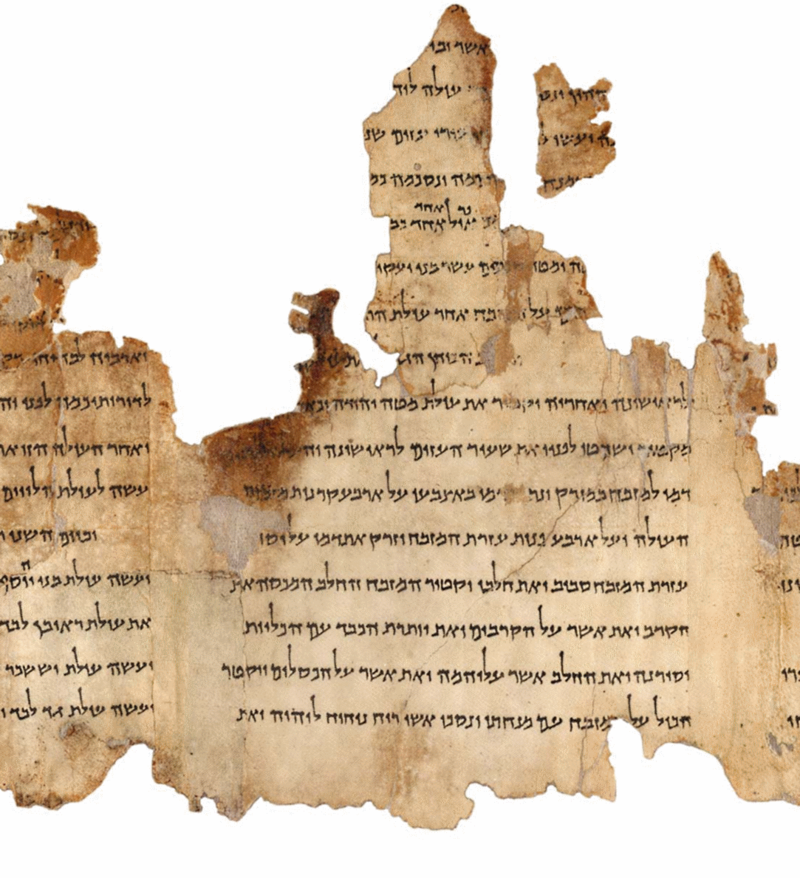
In November of last year, a question arose as I was reading through the Dead Sea Scrolls. The unknown author(s) of many of these ancient documents from Qumran seems to take some amazing liberties with regard to authoritatively giving his own interpretation (often titled “pesher”) or spin on the scripture of his day. In other places the author simply declares the word of the Lord. Take this remarkable passage from cave 4, translated from fragment 4Q371-3:
“I shall praise the Lo[rd that] my meditation [might] be pleasing to Him […] [and] heart, to teach understanding […] judgment, for my word is [swee]ter than honey, [my] ton[gue] more pleasing than wine. [Every word that I speak] is truth, every utterance of my mouth, righ[teousness]. None of these testimonies shall fail, none of these fine promises perish, for all of them […] The Lord has opened my mouth, the words that I speak come from Him. His word is in me, so as to declare [… To us belong] His mercies; He shall not grant His laws to another nation; neither shall He adorn any stranger with them. Surely […] [A]braham, for He made a covenant with Jacob to be with him for all etern[ity…” Portion 4, lines 4-9, as quoted from Dead Sea Scrolls, A New Translation, by Michael Wise, Martin Abegg Jr., & Edward Cook p. 334
Compare the audacious words of this author with this passage we read from Isaiah in the Bible:
I clothe the heavens with darkness and make sackcloth its covering. The Sovereign Lord has given me a well-instructed tongue, to know the word that sustains the weary. He wakens me morning by morning, wakens my ear to listen like one being instructed. The Sovereign Lord has opened my ears; I have not been rebellious, I have not turned away. … Because the Sovereign Lord helps me, I will not be disgraced. Therefore have I set my face like flint, and I know I will not be put to shame. He who vindicates me is near. Who then will bring charges against me? Let us face each other! Who is my accuser? Let him confront me! It is the Sovereign Lord who helps me. Who will condemn me? They will all wear out like a garment; the moths will eat them up. Isa 50:3-9, NIV
Here Isaiah begins with words that are a direct quote from God. If you were completely unfamiliar with Isaiah and were reading this for the first time, these statement could seem quite bold (or course, it is bold even when you are familiar with Isaiah). These words not only apply to Isaiah himself, but are prophetic words that apply to Christ.
How are the words from the unknown author in the Dead Sea Scrolls different from the bold testimony we see written by Isaiah? Was this person from Qumran inspired like Isaiah (or Jeremiah, or David, or Paul)? Why couldn’t I accept these words as scripture? For me, I am inspired by these words. I feel like exclaiming, “Now that is remarkable! We don’t know where he comes from, yet he opens my eyes.”
As I do with the Bible, I expand my understanding by comparing translations of the Dead Sea Scrolls. I hope this index proves useful to those seeking a deeper experience by being able to navigate between translations.
Not knowing how to read ancient Hebrew or Aramaic, I’m left to rely on someone else’s interpretation of the Dead Sea Scrolls in English. Like I do with the Bible, I have discovered I can expand my understanding by comparing translations.
When I decided to read the Dead Sea Scrolls, there were three main translations that competed for my attention:
Not knowing anything about the Dead Sea Scrolls and basing my decision off reviews and the description of the book, I purchased Dead Sea Scrolls, A New Translation, by Michael Wise, Martin Abegg Jr., & Edward Cook (hereafter abbreviated as DSSNT). Later, in order to compare translations, I added to my library The Dead Sea Scrolls Translated, Second Edition, by Florentino Garcia Martinez (hereafter abbreviated as TDSST).
The fragmentary nature of the scrolls makes it an arduous task to read through any translation of these scrolls. One must be rather serious and committed in order to find the nuggets of wisdom to be found there.
Without some form of bearing on the landscape and background of the different scrolls I would have been somewhat lost without the commentary provided in the Dead Sea Scrolls, A New Translation (DSSNT) by Wise, Abegg and Cook. Unless you are familiar with some of this background information you would almost need a companion text like James VanderKam’s The Dead Sea Scrolls Today, to fully appreciate The Dead Sea Scrolls Translated (TDSST) by Martinez, where he presents the full translation without commentary on the individual manuscripts.
When I began to try to compare the two translations (DSSNT and TDSST) I quickly discovered how challenging it was to find a given manuscript in the other translation. Between the two, the manuscripts of the scrolls are organized in completely different ways. The Index of Manuscripts in the Epilogue of DSSNT became an invaluable resource. At the end of TDSST there is a List of the Manuscripts from Qumran, but it was not immediately apparent to me that I could find the page number for a given manuscript within TDSST using this list, as it is a comprehensive list of all the scroll manuscripts, including those not included in the book. Only listings included in the book have a page number reference. I spent several weeks composing an index of my own to help me navigate between them, which can be found below.
Having solved the problem of being able to find the manuscripts between the two translations, I could now more easily compare them, which has given me a richer experience in understanding the beauty of these wonderful ancient scrolls from Qumran.
I give here only a few examples:
1QH Col 18:33-34
DSSNT p. 106 “My heart behaves as if mad in anguish and my loins tremble. My groaning enters the depths and completely searches out the chambers of Sheol.”
TDSST p. 352 “My heart flutters in anxiety, my kidneys in alarm, my sigh reaches down to the abyss, even pierces the caverns of Sheol.”
1QH Col 16:11-12
DSSNT p. 102 But You, O [G]od, You protect its fruit with the mystery of powerful warriors, holy spirits, and the whirling flame of fire so that none may [come to the] fountain of life
TDSST p. 345 But you, O God, you protect your fruit with they mystery of powerful heroes, of spirits of holiness, so that the flame of the searing fire [will] not [reach] the spring of life
1QH Col 17: 15-17
DSSNT p. 104 one person may be wiser [than his fell]ow, humanity is more honored than a vessel of c[lay], and one spirit may surpass another spirit; but as for Your mighty str[ength], no power can compare. To your glory there are no [bounds, and] to Your wisdom there is no measure,
TDSST p. 348 a fellow is wiser [than a fellow,] the flesh is respected more than one made from [clay,] one spirit is more powerful than another spirit; but before your might, nothing is strong, and nothing is [comparable] to your glory, and to your wisdom there is no measure,
4Q417 Frag 2 col 1:6-12
DSSNT p. 380 [… at night meditate on the secret] of why things are and investigate it at all times, and then you will know truth and evil, wisdom [and falsehood … Consider the wicked] in all their ways, with all their punishments throughout the world-eras and the eternal punishment
TDSST p. 387 [… day and night meditate on the mystery of exis]tence and always investigate. Then you shall know truth and injustice, wisdom […] … […] in all his paths with his visitations through all the eternal periods, and the eternal visitation.
4Q418 Frag 81:15-20
DSSNT p. 387 You are one who understands, if He has made you rule over the skill of His hands, and know […] goodness for all humans who pass by, and from there you will attend to your food […] consider well and add to your learning by listening to all your instructors […] show your poverty to all who seek pleasure and then you will establish […] you will be filled and satisfied by abundant goodness and by the skill of your hands […] for God has distributed an inheritance to every [living thing] and all those who are wise at heart will have success […]
TDSST p. 391 And you, understand; if through the wisdom of hands he has given you dominion, […] extension (?) for every man who walks. And from there he will administer your nourishment […] Understand the praised one, and by the whole hand of your sages add […] Show your lack to all those who seek delicacies. Then you will understand […] Fill and be replete with the abundance of goodness and the wisdom of your hands […] for God has divided the inheritance [of every living creature] and all those wise at heart understand […]
Overall, if I had to only select one translation I would recommend Dead Sea Scrolls, A New Translation, by Wise, Abegg, & Cook. Not only do they provide insightful commentary to help you navigate the landscape of the scrolls and great resources in their Epilogue, their translation seemed to capture what felt to me like a better essence of meaning. Having said that, I have to say there were many cases where I felt in The Dead Sea Scrolls Translated by Martinez, he captured passages in a way that resonated as something truer to my understanding of things. I cannot speak to what is a better translation as I have no experience with the original ancient languages. I can only compare with my own perceptions as I understand things and try to remain open to truth wherever it comes from.
Whatever translation you choose, I advise the reader to take the effort to read at least some edifying Dead Sea Scroll manuscripts like the Thanksgiving Scroll (1QH, 4Q427, and 4Q429), Wisdom scroll on the Secret of the Way Things Are or Mystery of Existence (4Q416-418), Blessings of the Wise (4Q525), and Apocryphal Psalms of David (11Q5-6; 4Q88, 4Q448). There are many delightful nuggets of wisdom that are sure to enlighten and uplift in the Dead Sea Scrolls. Your time will not be wasted in searching them out.
God bless,
Jay Ball
Dead Sea Scroll Index, Comparison of English Translations
The following index connects Dead Sea Scroll manuscript numbers with where they can be found in the english translations: The Dead Sea Scrolls Translated, Second Edition, by Florentino Garcia Martinez (abbreviated as TDSST) and Dead Sea Scrolls, A New Translation, by Michael Wise, Martin Abegg Jr., & Edward Cook (abbreviated as DSSNT)
There are many duplications in the Dead Sea Scroll manuscripts as copies of the same information were found on various scrolls. For this reason Wise, Abegg and Cook in their translation Dead Sea Scrolls, A New Translation (DSSNT) have attempted to make it easier on the reader by taking the manuscripts where there is duplication, and combined them together and organized these into sections called “texts”. In the Epilogue of their book they have provided a very helpful Index of Manuscripts where they reference Dead Sea Scroll manuscript numbers to the text numbers they have assigned in their book. I have used their index as a base from which I have structured my index below.
The scroll manuscript numbers reference to the page (and text) numbers where the given manuscript can be found in the referenced translations. Because they have combined several manuscripts into one text within DSSNT, it is not always evident specifically where the given Dead Sea Scroll manuscript may be referenced. In these cases I have used parenthesis () to reference the page number where the text translation begins.
Italicized text represents references to sub sections of texts within a given scroll manuscript to further refine links to passages that would otherwise be difficult to find within the overall scroll manuscript between the translations.
I hope this index proves useful to those seeking a deeper experience by being able to navigate between and compare the translations.
Why is it that we value differences in personality types in the workplace, but when it comes to the sexes, the perception at least, is that we want them equalized?
Note: I attempted to pack too much into one article when I originally published this piece. Breaking this post up into several separate posts would have made it more coherent. As it stands, it has served as an excellent reference tool for me to come back to as a resource for this subject matter, but reading it now feels too disjointed to be taken as a well written article on its own. Jay Ball – 27/Mar/2023
Early last year, the women’s network at the company where I work held a lunch meeting and “TED Talk Panel Discussion”. I wasn’t sure what that was, but I was tempted by the offer for a free lunch, so I attended.
At first I hesitated because, well, what reason did I have to attend a women’s networking meeting where all they were going to do is talk about women in the workplace, how to recognize signs of discrimination, raise awareness of harmful stereotypes, and listen to women talk about their need to be treated fairly, etc.
I admit I am surprised at what I picked up in that meeting. More on that in a minute.
Women’s Networking Meeting
The meeting opened with lunch while we watched a TED Talk video, Start with Why – how great leaders inspire action by Simon Sinek. This was followed by a panel discussion with some of the leadership. Finally, in the last 15-20 minutes there was a panel of four men who shared what they recently learned from attending a company sponsored training workshop called MARC (Men Advocating Real Change).
Simon Sinek’s TED talk and the discussion that followed was informative. Enlightening. I took notes. I won’t take the space here to share all the points of Simon’s speech. You can go watch it (14 minutes) here, but the key points of his speech that relate to my thoughts here, were about how the human brain has three parts that align with what he diagrammed as “the golden circle”.
“None of what I’m telling you is my opinion,” Simon told us. “It’s all grounded in the tenets of biology. Not psychology, biology.”
He explained, “Our newest brain, our homo sapien brain, our neocortex… is responsible for all our rational and analytical thought and language.
“The middle sections make up our limbic brains and are responsible for all our feelings, like trust and loyalty. It’s also responsible for all human behavior, all decision making, and it has no capacity for language.
“When we communicate from the inside out, we’re talking directly to the part of the brain that controls behavior. Then we allow people to rationalize it with the tangible things we say and do. This is where gut decisions come from.”
War of Sexes
Then the atmosphere seemed to shift when the panel of four men came forward to share their experience from the MARC training they attended. I say I felt a shift, but this is possibly only my experience. I really can’t speak for anyone else. My preconceived ideas about this part of the meeting shaped how I processed the information that was presented. I perceived them as whimpering dogs with a tail between their legs as they were beaten into submission under the hands of the parent organization, Catalyst, whose mission is to “help build workplaces that work for women”. I wanted to return from the meeting and tell my fellow male co-workers that the reason I went was because I consider myself a real man and I mistook the name for “Real Men Advocating for Change”. In the end I’m happy to say that I have had a humbling shift in my attitude, but not how you might think. I will explain later. But here let me clarify why it is that I feel so uneasy confronting this subject.
My biggest discomfort arises from the many accusations from parties on both sides in a war of the sexes. It disturbs me to realize how easy it could be for a simple accusation from the wrong woman in an inopportune circumstance to destroy an undeserving man’s career. On the other hand, it is heartbreaking to hear of sexual harassment that many women endure at the hands of brutish men who feel it their privilege to treat a woman with disrespect as if she weren’t even human. When the cries of injustice and accusations escalate the battleground fills with more appalling stories that the other side uses to justify even greater extremes. Who will win and where will it end? Not unlike the fields of war this bloody battleground will continue until it is filled with rotting carcasses of the dead and wounded where there are no winners and we all come out losers.
At the heart of this division is an attitude of accusation and fear. What I’m hoping to explore in this article is where do we find harmony and balance? Is it really necessary to point out the wrongs of the other party before we can find virtue in both?
There is little comfort for me in the promises of those promoting a doctrine of diversity and inclusion using flowery language like this taken from GlobalDiversityPractice.com: “Diversity allows for the exploration of these differences in a safe, positive, and nurturing environment. It means understanding one another by surpassing simple tolerance to ensure people truly value their differences.”
Being a peacemaker at heart, it may sound illogical for me to take issue with such a peacefully worded statement. But the statement left me to wonder why we are so quick to assume that exploring differences in “a safe, positive, and nurturing environment” means a guarantee that someone’s feelings won’t get hurt. My experience is that the greatest moments of awakening and realization happened for me because someone had the courage to challenge my thinking without fear of hurting my feelings.
Let me back up for a minute. It may not be evident where the statement says anything about hurt feelings, so I want to ask, what does “surpassing simple tolerance” look like? Could it look like an effort to temper disagreements? If tolerance requires disagreement (because insisting on agreement is not tolerance, but it’s opposite), then how does one, in an environment of differences, achieve a state that “surpasses simple tolerance”?
I don’t want it to appear that I’m getting off topic, but it’s important to establish that to implement diversity and inclusion in the workplace, any suppression of speech in the name of “surpassing simple tolerance” will be counterintuitive to the very objectives we are trying to promote. As President Obama said, “efforts to restrict speech can become a tool to silence critics, or oppress minorities… the strongest weapon against hateful speech is not repression, it is more speech.” [1]
In other words, in an effort to create a peaceful environment, it’s possible that an attempt to suppress conflict can engender a climate where people feel unsafe, rather than feeling safe in expressing their views. The best way to ensure the exploration of differences in “a safe, positive, and nurturing environment”, is to allow for the expression of tolerant views, even if those views may offend or give insult to others. [2]
Take, for example, an experience Eldra Jackson shares at TEDWomen 2018. In his speech, Eldra attributes “24 years of a life sentence in prison for kidnapping, robbery, and attempted murder” on “a disease that has come to be known as toxic masculinity.” [3]
He found a cure through Inside Circle, an organization founded by Patrick Nolan to combat gang violence in the prison yard. Through an exercise called Circle Time — “men sitting with men and cutting through the bullshit and challenging structural ways of thinking” — Jackson learned that “characteristics usually defined as weaknesses are parts of the whole, healthy man.” It is because men can share candidly and openly without worrying if their words might offend that the program is able to make such impact in these men’s lives.
There is another reason I bring up Eldra’s story. He introduces the subject of toxic masculinity. Toxic masculinity refers to certain norms of masculine behavior that are associated with harm to society and to men themselves. In the panel discussion that I attended, one of the men related an example given in the MARC training that made me stop and think. On the playground, when boys want to insult one another they will call the other a “sissy” or “girl”. Think about how it would make you feel if the object of insult among your peers was to call someone “insert your name here”.
There is a consensus that as a society we need to stop this kind of behavior. We need to nip this in the bud and stop tolerating such abusive or stereotypically negative language used by our children. For me it begged the question, why is it an insult to manhood to be considered feminine? I’m going to borrow from Simon Sinek and suggest that it has to do with biology, not psychology. I will explore this in a moment, but there was another question that arose in my mind that also created some tension for me. Why is it that we value differences in personality types in the workplace, but when it comes to the sexes, the perception at least, is that we want them equalized? [4]
Personality Types and The Sexes
According to the personality profile assessment from a training I attended at work several years ago, I am primarily Analytical with strong undertones of Amiable. The four types from this particular profile classify personality types into four categories; Driver, Analytical, Amiable and Expressive. Other popular personality assessment tools include Myers-Briggs (MBTI®), the DiSC profile, published by Wiley, and Taylor Hartman’s The Color Code. Employers often use personality assessment tools in trainings or workshops to help employees identify and relate to each other in healthy ways. Organizations conduct such trainings because they understand how it helps to improve communication, avoid and resolve conflicts and improves professional relationships.
When it comes to personality types, we appreciate and even try to capitalize on the differences. Why don’t we try to do the same when it comes to the sexes? [5]
Characteristics of Masculine and Feminine
Above, I suggested the idea that name calling on the playground could relate to something in our biology, but I confess this is mostly my assumption. My purpose here is to focus on differences between masculine and feminine attributes over differences between the sexes. [6] I would use the word biology only in the sense that generally men are more likely to be dominant in masculine characteristics and women more dominant in the feminine. It is important to recognize that both men and women exhibit characteristics of both feminine and masculine attributes. In other words, we do see cases of men who are dominant with feminine characteristics and vice versa, but we all share moments where we step into one or the other of the two roles. For the purposes of this discussion, I want to disassociate gender from the discussion and focus on traits of the masculine and feminine. For this reason I will use the pronoun “he” to describe one who is dominant in the masculine traits, and “she” for one who is dominant in her feminine, regardless of gender.
Recall that in his TED talk, Simon Sinek spoke about a part of the brain that has no capacity for language. “Sometimes you can give someone all the facts and figures and they may say, ‘it just doesn’t feel right’. Why would you use that verb, it doesn’t ‘feel’ right? Because the part of the brain that controls decision-making doesn’t control language. And the best we can muster is ‘it just doesn’t feel right’. Or sometimes you say you’re leading with your heart, or you’re leading with your soul.”
Much of what I am about to say comes from a sense of what “feels right” to me. Language may be a hindrance to me here. What I am attempting to communicate are concepts and ideas without getting too hung up on the words.
Rather than begin by simply making a list of feminine and masculine attributes, I would like to approach this from a different perspective.
If I were to try to paint a picture with words to describe what feminine is, I might use language to say she is elusive like the wind. She is the sparkle of sunlight shimmering off ripples on the surface of a lake. She is uncontained like the ocean. The masculine, on the other hand, could be likened to a ship on the ocean. It captures the wind in its sails and charts a course. It is direction and purpose. It focuses its attention and energy to the accomplishment of a goal. There is power in the feminine. Like the ocean, she has power to crush the ship to smithereens in an instant. When the two work together it becomes possible to reach the desired destination.
Different disciplines from yoga to childbirth preparation to meditation have used breathing as an aid to practicing mindfulness. Many of these practices teach how breath and breathing relates to masculine and feminine attributes. I particularly like the imagery of the breath and what meaning can be drawn from contemplating how it relates to masculine and feminine attributes.
There are a number of meditative practices where the inhalation symbolizes a feminine energy and the exhalation symbolizes a masculine energy. Inhalation signifying the feminine is apt because the very first breath a baby takes when it is born is an inhale, which represents life. The feminine yearns to take in joy and be filled with love. Masculine signified by an exhalation is apt because the very last breath of life is an exhale, representing death. The nature of the masculine wants to draw things to an end, reach a conclusion. It lives on the edge, faces risk, seeks freedom from constraints and aspires to empty itself of stress. We can see the masculine and feminine aspects embodied in the breath. Each breath we take exhibits the working together of both masculine and feminine attributes.
In many cultures, both ancient and modern, the sun and moon are symbols of masculine and feminine. The sun is an example of a warmer working energy representing the masculine. The moon represents the softer cool and refreshing energy of the feminine. From the surface of the earth they occupy equal space in the heavens. Although the circumference of the sun is approximately 400 times larger than the moon, the moon is approximately 400 times closer to the earth. As a result they are visibly equal in size and occupy the same path on the ecliptic. This is why the moon is able to eclipse the sun.
The sun, is stable, unchangeable, reliable and predictable. The sun rises every day on the horizon in the east and sets every evening on the horizon in the west. He is unvarying in his course from day to day and year to year. The feminine, represented by the moon, changes each day. She waxes and wanes. She does not just move from east to west, but the moonrise also constantly moves in the opposite direction from west to east. Every day she reappears further to the east before beginning her movement to the west. She moves approximately 50 minutes eastward each day.
Her complex movements overhead were part of the reason she was known anciently as “The Great Dancer.” Her movements display constantly changing motions, contrasting with her companion sun. This contrast between the movements of the sun and the moon brings to mind the quip by cartoonist Bob Thaves about Ginger Rogers, the dancing partner of acclaimed Fred Astair, “Sure he was great, but don’t forget that Ginger Rogers did everything he did…backwards and in high heels.”
Using some of this imagery, and without making any claim or attempt to be comprehensive, some key traits that we can associate with the masculine include courage, assertiveness, strength, boldness, and confidence. Feminine traits include sensitivity, nurturing, attentiveness, and beauty. Again, this does not suggest that women can’t be bold or men cannot be sensitive.
The epitome of masculine is war. War typifies all the elements we associate with the masculine, like taking risk, facing death, exhibiting strength, pushing past boundaries, and seeking freedom. We can see the elements of war imagery played over into sports. Constraints are set up and a goal established. Then the players engage in a battle against the other team to take risks and push past boundaries to freedom. May the strongest and most assertive team win. Or, put another way, may the most masculine team win. You hear imagery of these masculine traits carry over into our language. A phrase like “we slaughtered them” is used to describe an impressive win in sports. Succeeding in business is expressed as “killing it”, and in wishing success in a presentation or on stage one may say, “knock em’ dead”. I would suggest that on the playground where it is an insult for boys to be called anything feminine is not as much an indication of incorrect upbringing as it is that, at its core, language is reflecting something from deeper in the brain. Remove gender from the equation, and what I am saying is that it is a legitimate insult to the masculine to be referred to as its opposite. The gift of the masculine is that its power lies in being decisive, acting tenaciously in pursuit of the goal, taking the bull by the horns and getting the job done. When the situation calls for aggression, an effeminate response is not only counterproductive, it can be outright dangerous. Does this mean there is no place for a feminine response? Absolutely not. But in the heat of the game, when the ball is on the 20 yard line, or in a case where the life or death of the business lies on having the guts to take a bold risk, these situations call for a masculine response. It is no insult to the feminine in these cases, in fact it is complimentary. More on that later.
Business as a Masculine Arena
There are countless books and articles that compare business with strategies and tactics used in war, as summed up in this statement from an article from FastCompnay, “Business in the New Economy is a civilized version of war. Companies, not countries, are battlefield rivals.” [7]
Winning in war or business involves all the elements that make up what I am calling masculine traits. I believe it is helpful to recognize that when you are talking about business, you are talking about a game that is being played in a masculine arena. This can create a certain tension for those who are dominant in feminine traits (naturally made up mostly of women), who are trying to compete in this arena. Instead of feeling weak and helpless in a situation that is beyond one’s control, seeing the reality of the picture in its true light should empower, not discourage.
In his Simploelogy training, Mark Joyner describes one of the lessons that had the most impact in his military education. When he was a US Army Officer attending the Field Artillery Officer Basic Course in Fort Sill, Oklahoma, an influential military teacher taught one impactful lesson asking “Which one of you wannabe-officers can tell me the single essential skill of a leader?” After the young new 2nd Lieutenants fumbled around with finding an answer for about 20 minutes he finally revealed the answer: “What defines a leader, more than anything else, is his ability to see the battlefield.” [8]
What will be most helpful for the feminine (as well as the masculine) in the business arena, is to “see the battlefield”.
In a featured MARC article Victoria Roseberry compared feminine traits such as empathy and emotional awareness with masculine traits. She observed: “Traits traditionally associated with male gender roles, such as dominance, assertiveness, and confidence, are also those that are considered essential for leadership positions.”[9]
Consider that if you have an all-women’s basketball team, the game is still basketball. Forgive the stereotype here, but if you were to run across a men’s-only craft show, it would still be a craft show. It’s not about who the participants are, it is about what the game is. In this case, the game is business. No matter who is participating, if you are engaged in the business of doing business, it’s business. By nature, winning in this arena goes to the most masculine.
To liken this with war, imagine you are battling it out with an opponent on the battlefield. With sword in hand you approach your opponent. Losing means you will die. Winning the battle involves all the characteristics associated with masculine. It may involve strength and courage, but can also include wit and strategy. It involves all the planning and preparation that played a role before even engaging in the fight. Recall the scene from Raiders of the Lost Ark where Indiana Jones came face to face with a threatening sword wielding bandit, and pulled out his gun and shot the sucker. I’m not making any argument for or against rules or what is right and wrong. I’m simply saying that everything I just described exemplifies the masculine, and can be applied to the game of business.
This discussion isn’t about the reality of the abuses on both sides that take place in the battle of the sexes. We know that sexual harassment against women in the workplace is real. When it comes to competing and winning in the business world, women deal with a higher ‘specific gravity’ that men simply don’t identify with. It’s true that men work with a tailwind pushing them forward where women must fight against a harsh headwind. That’s why organizations like Catalyst exist. They serve to educate us about these realities. Acknowledging these realities is important, just as it is important to know the nature of the arena in which you find yourself in the business world.
Does this mean there is no room for the feminine in business?
How does this fit with allowing for differences in sexes just like we appreciate differences in personality types? Does this mean that there is no room in business for feminine traits?
Just as every analytical or amiable personality type who doesn’t have a desire to work their way into supervisory roles serve happily where they do best in the workplace. Likewise, not everyone with a feminine dominant personality has a desire to battle her way into the top positions, but may happily contribute where she serves best. The workplace needs each personality contributing their best with the talents they individually bring.
If the position you seek and the role you want to play in the workplace requires ambition, drive, strategy, and courage, you may find yourself competing for that position in the same arena with others of like mind. Recall the Always ad campaign #LikeAGirl where the question is posed, “Why can’t run like a girl also mean win the race?” Running like a girl doesn’t mean you can’t run just like yourself and still win. Just realize it’s not about whether you are a boy or a girl running any more than playing and winning at basketball on an all-women’s team is about women doing the playing. It’s about basketball, and the team that wins is the one who best employed all the elements I’m trying to define here as masculine.
Cesar Millan gives a great example of what I’m talking about: “I used this trick a few times on ‘The Dog Whisperer with Cesar Millan,’ but one that stands out for me is a woman who could not control her dog on the walk. This was because she was showing weak energy, so the dog was pulling her all over the place. When I asked her to think of a character who inspired calm, assertive energy, she chose Cleopatra — and once she started to carry herself like a queen, everything changed. Her dog followed her immediately, and once her dog showed calm, submissive energy, she became even more confident.” [10]
So what is the gift of the feminine?
Earlier, I related the feminine to the ocean, saying she has power to crush a ship to smithereens. But the word power, as I have used it in this article so far, is a term of strength and energy; words I have associated as masculine traits. Is there power in the feminine? When composing my thoughts at this stage in this article, this question perplexed me. In thinking of power in terms of courage, stamina, and energy, I struggled with trying to put my finger on where is the power in the feminine.
So far I have been contrasting power to how it relates to things like war, sports, and business being played in a masculine arena. It’s a masculine game. “Game” in the masculine sense has boundaries and rules and a goal. It seeks freedom. Power (or the ability to do) in the masculine sense is the ability to accomplish the end result. Win the game, battle and conquer without dying first, succeed in business, etc.
“Game” in the feminine sense is about play and being in the moment. It is love. It’s not concerned with the boundaries, rules or goals. Power in the feminine is the ability to be in the moment. The ability to sense when others are not performing at their best in the moment. The ability to enjoy the game while you are playing it. The ability to be spontaneous as well as attentive, and to nurture. The feminine is not trying to bring things to conclusion, close the book, or end the debate. She just is.
The masculine is constancy amid change. The feminine is change. Where the masculine gets his bearings by learning from past mistakes and charting a better course going forward, the feminine lives in the present. You may be on time for every meeting consistently for 10 years. But you can be late just once for an important meeting and catch the wrath of the feminine. Your track record doesn’t matter to her. This is because the role of the feminine demands you be your best here and now.
When it comes to power in the feminine, we are talking about a different game altogether. I’m reminded of an episode of Star Trek[11] where Data is pushed to challenge the arrogant Kolrami, assuming Kolrami will be no match for Data’s android reflexes and computational ability. When the two play, however, Data is soundly beaten, causing him to become convinced he is malfunctioning. Later Data challenges Kolrami to a Strategema rematch. This time, Data is able to hold Kolrami in check; Kolrami grows more and more frustrated as the match progresses, ultimately throwing down his controls in disgust and storming off. Data explains that he altered his strategy, giving up opportunities for advancement in order to maintain a stalemate, which he believes he could have maintained indefinitely. The feminine isn’t trying to change the rules. She’s just playing a different game.
What is the ideal form of feminine?
If the epitome of the masculine is war, then what is the epitome of the feminine? I considered the metaphor of the breath, where masculine relates to death and the feminine relates to life. What more apt representation of life than the first breath taken by a newborn baby at birth? What is more completely feminine than motherhood? Then I considered that in the process of bringing life into the world, a mother faces the risk of death for both her and the unborn child. No matter how wonderfully modern technology is able to minimize that risk, the risk is always present. In a way that no man can fully appreciate, in the birth process a woman faces the key elements that I have listed as masculine – risk, strength, courage, living on the edge, facing death – how curious. What is the difference between a woman facing death while giving birth, and a soldier facing death on the battlefield? [12] The most obvious difference to me is the very real and intimate way that she risks her life to bring life into the world.
No woman ever describes birth with phrases like “killing it”, or “knockin ‘em dead”. Neither will you ever hear the insult “she gives birth like a boy”. Feminine stands in her own space apart from the masculine with a natural sense of light and joy. There is no prideful glory in motherhood. [13] The feminine steps up to her calling, faces the risk and endures it nobly.
St. John put it well: “When a woman is giving birth, she has sorrow because her hour has come, but when she has delivered the baby, she no longer remembers the anguish, for joy that a human being has been born into the world.” (John 16:21)
Every infant comes into this world in profound need. The child’s existence is dependent on the nurturing care of the feminine, which care is always given at the sacrifice of other things she might be doing. In that sense it is a selfless act of kindness, because raising an infant is never convenient.
Except for what happens in the womb of the woman, everything else in our human condition is subject to entropy. Women have power to produce new life. Everything else decays and dies. Her power defies the universal effects of entropy.
I do not mean for this to sound like a Sunday Mother’s Day sermon, but I confess it is difficult for me to compose my thoughts on this topic without a sense of reverence. Many women choose not to become mothers. I want to remind the reader that I’m not talking about women, but traits of the feminine. What I am exploring here is the polar opposite of masculine death and war with feminine birth and life. I am suggesting it is in birth where we see the greatest gifts and most noble traits of the feminine.
Motherhood in the Workplace?
So if the topic of this article is dealing with women in the workplace, how does motherhood fit into the picture of the workplace? It doesn’t. Though there are women who seek for careers and who find themselves sacrificing motherhood in order to compete with men in the business world, [14] that is off topic. What I am focusing on is appreciating the differences between the masculine and feminine attributes. As it relates to this topic, motherhood only comes into the picture as it reveals the most dignified traits of the feminine, and how that helps give contrast to its relationship with the masculine.
Mothers are known to have a sense of intuition about what their children are doing in the next room. [15] This intuitive sense is more keen with experienced mothers and sometimes she is able to sense when her child is in trouble even when he is far away. This intuitive sense is also seen with experienced basketball players who can tell when an opposing player is right behind her on the court. Or with an experienced fisherman who can sense right where the fish will be biting that day. But intuition and experience are things that contribute to an even greater feminine characteristic I will call wisdom. Psychology Today gives this perspective:
“Wisdom is one of those qualities that is difficult to define—because it encompasses so much—but which people generally recognize when they encounter it. And it is encountered most obviously in the realm of decision-making. Psychologists tend to agree that wisdom involves an integration of knowledge, experience, and deep understanding that incorporates tolerance for the uncertainties of life as well as its ups and downs. There’s an awareness of how things play out over time, and it confers a sense of balance. It can be acquired only through experience, but by itself, experience does not automatically confer wisdom.”
Masculine Knowledge and Feminine Wisdom
In ancient texts wisdom is referred to as feminine: “Wisdom hath builded her house, she hath hewn out her seven pillars:” (Proverbs 9:1)
In Hebrew it is called chokmah [הָמְכָח] (phonetically khokmaw’), which is a feminine noun. In Greek it is sophia [σοφία] which is likewise a feminine noun. Where wisdom has been referred to as the gift of the feminine, knowledge is the gift of the masculine. Only together do they become complete.
I like this description of the difference between knowledge and wisdom from Diffen.com: “’Where is the wisdom we have lost in knowledge? Where is the knowledge we have lost in information?’ —T.S. Eliot. Knowledge is gathered from learning and education, while most say that wisdom is gathered from day-to-day experiences and is a state of being wise. Knowledge is merely having clarity of facts and truths, while wisdom is the practical ability to make consistently good decisions in life.”
Francis Briers from Integration Training talks about the art of cultivating wisdom in organizations in this informative 5 minute video.
So, to wrap this up…
There may be some grey areas and overlap on some characteristics that we could classify specifically as feminine or masculine. I have made no attempt to define the separate traits comprehensively. My objective has been to acknowledge and point out differences in hope that we can appreciate the beautiful way they work together, where alone they are barren and unfruitful. Knowledge alone may provide a spark of energy, but it can be potentially dangerous if it is not wisely directed. Wisdom alone is not an agent of action. Knowledge can initiate action, but wisdom is necessary to guide and counsel.
I think the point I’m trying to make is illustrated well with this example of Alexander the Great. I love this quote from Steven Pressfield in his book, The Virtues of War, where Alexander is talking: “How does one make decisions? By rationality? My tutor Aristotle could classify the world, but couldn’t find his way to the village square. One must dive deeper than reason. The Thracians of Bithynia trust no decision unless they make it drunk. They know something we don’t. A lion never makes a bad decision. Is he guided by reason? Is an eagle ‘rational’?… Great commanders do not temper their measures to What Is; they bring forth What May Be.” (The Virtues of War, Steven Pressfield, p. 202)
Alexander and other great leaders were able to trust in a sense of something outside of reasoning or knowledge alone. They had the boldness and courage to take actions in moments that required a split decision where the success or failure of many lives, the army, or even the nation hung in the balance. Yet they allowed this to be tempered by the intuition and experience of wisdom.
Near the beginning of this article I mentioned that my objective is to find harmony and balance. I like how Keith Merron put it: “The degree to which the masculine and feminine qualities are represented and are utilized well is the essence of balance.”[16]
Yes, masculine and feminine are opposites, but they are meant to be complementary opposites. They each have negative and positive traits. In this article my focus has been on the positive traits. Great things can, do, and should continue to happen when we recognize and appreciate the complementary nature of the differences between the sexes.
2 “The clear problem with the outlawing of insult is that too many things can be interpreted as such. Criticism is easily construed as insult by certain parties. Ridicule is easily construed as insult. Sarcasm, unfavourable comparison, merely stating an alternative point of view to the orthodoxy can be interpreted as insult. And because so many things can be interpreted as insult, it is hardly surprising that so many things have been“. (New Intolerance speech, Rowan Atkinson At Reform Section 5 Parliamentary Reception, October 21, 2012, https://lybio.net/rowan-atkinson-at-reform-section-5-parliamentary-reception/speeches/)
5 It appears there has been some notable work done on the topic of appreciating the differences in the sexes that is worth exploring: “Other scholars believe the gender imbalance exists primarily due to innate differences in men’s and women’s perceptions, decisions, and behaviors. For example, research has found that men are more likely than women to engage in dominant or aggressive behaviors, to initiate negotiations, and to self-select into competitive environments — behaviors likely to facilitate professional advancement.” (Explaining Gender Differences at the Top by Francesca Gino and Alison Wood Brooks, Sep 23, 2015 https://hbr.org/2015/09/explaining-gender-differences-at-the-top. See also 8 Blind Spots Between the Sexes at Work by Susan Adams, https://www.forbes.com/sites/susanadams/2013/04/26/8-blind-spots-between-the-sexes-at-work/#4c3d6428314d)
6 “But are these outcome differences due to biological differences? While there are (of course) biological differences between the sexes, social science has shown that men and women are more similar than different on a wide range of characteristics, from personality to ability to attitude — and that these factors have a larger effect on career outcomes than biology does.” (What the Science Actually Says About Gender Gaps in the Workplace, Harvard Business Review, Stefanie K. Johnson, Aug 17, 2017, https://hbr.org/2017/08/what-the-science-actually-says-about-gender-gaps-in-the-workplace)
12 There is a natural and inevitable affection children hold for their mothers. That affection is close to the hearts of all dying men. There are many battlefield accounts of how dying men call out in their last breath for their mother. Roland Bartetzko, former German Army soldier, when under fire in his first combat experience uttered “Mother” when fire struck others beside him. As he reflected on why he spoke that out loud he concluded, “Our lives begin with our mothers giving birth to us and on the day when I thought that my life was over, my mind circled back to where it all had begun.” Roland Bartetzko, former German Army, Croatian Defense Council, Kosovo Liberation Army, Dec 14, 2016, Why do some soldiers call for their mother when they are dying on the battlefield?https://www.quora.com/Why-do-some-soldiers-call-for-their-mother-when-they-are-dying-on-the-battlefield?share=1 See also A Young Warrior’s Last Thought is for Mother, by Lt. Colonel James G. Zumwalt, USMC (Ret.), https://www.breitbart.com/national-security/2015/05/10/a-young-warriors-last-thought-is-for-mother/
13 I’m reminded of a comic routine by Bill Burr where motherhood is mocked in contrast to the hard working masculine. I agree with the nobility of men who risk their lives in worthy labor, but am disheartened at how this is used to belittle motherhood: “We’re watching it the other day, you know, Oprah’s on there. She’s interviewing some client, you know. She’s giving her this big ridiculous intro, like she’s done this, she’s done that, she’s done this… and “she’s done the most difficult job on the planet, she’s a mother”… she continues on… and immediately I just look at my girlfriend like, like really!? Being a mother is “the most difficult job on the planet”? Oh yeah, all those mothers who die every year from black lung from inhaling all that coal dust… There’s just this tornado of misinformation. “I have the most difficult job on the planet”. What would you rather be doing, drilling to the center of the earth, shaking hands with the devil every time there’s a rumble in the brow, you’re waiting for the whole thing to collapse down on top of you. Yeah, so they can write that folk song about you? Would you rather be up in the sunshine, running around with a couple of toddlers that you can send to bed anytime you want on some trumped up charges. Because you want to have a drink and watch the price is right, you know what I mean? I couldn’t believe it, “it’s the most difficult job on the planet”. Oh yeah. I thought roofing in the middle of July as a redhead, I thought that was the… but these mothers are bending over at the waist, putting DVDs in the DVD player. I don’t know how they do it. I don’t know how they do it. Dude any job that you can do in your pajamas is not a difficult job. Right? Gimme a break.” (peals of laughter) (Bill Burr on feminism, A comedian who talks about feminism. https://youtu.be/N0vZhz3sN_E)